The Strategic Role of Chi Ma in Vietnam – China Logistics
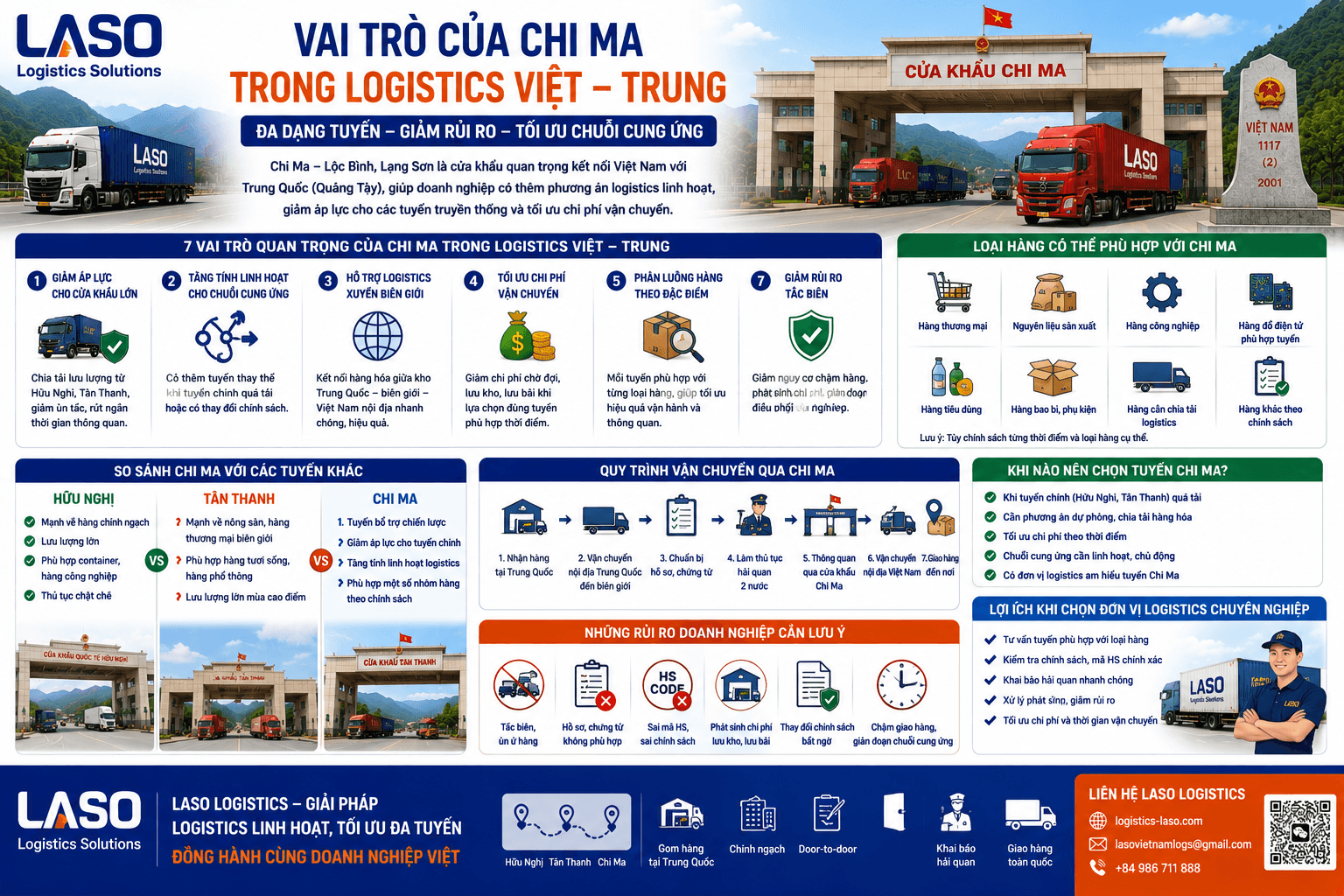
In the Vietnam – China logistics chain, when mentioning border gates in Lang Son, most enterprises immediately think of Huu Nghi or Tan Thanh. However, the Chi Ma border gate is increasingly playing a vital role in cross-border logistics activities, especially for businesses seeking optimized alternatives to reduce pressure on traditional routes.
With the robust growth of bilateral trade between Vietnam and China, diversifying logistics routes is no longer a secondary option but has become a crucial strategy to help businesses:
- Reduce border congestion risks
- Proactively manage the supply chain
- Optimize transportation costs
- Efficiently allocate cargo flows
- Accelerate delivery speed
So, what role does Chi Ma play in Vietnam – China logistics?
**What is Chi Ma Border Gate?**
Chi Ma is a border gate located in Loc Binh, Lang Son, within the Vietnam – China border region. This is one of the key logistics connection points between Vietnam and China's Guangxi region.
Although it does not handle as much volume as Huu Nghi, Chi Ma plays a strategic role in supporting the border logistics system.
**Why is Chi Ma Gaining Attention?**
As Vietnam – China trade continues to surge, relying solely on a few major border gates creates several risks:
- Congestion
- Delayed customs clearance
- Increased costs
- Supply chain disruptions
- Lack of flexibility
Chi Ma provides businesses with an additional logistics option.
**The Role of Chi Ma in Vietnam – China Logistics**
1. Reducing Pressure on Major Border Gates
This is the most critical role. Routes such as Huu Nghi and Tan Thanh often face heavy traffic, particularly during peak import seasons, holidays, agricultural harvest peaks, and periods of enhanced regulatory control. During these times, Chi Ma serves as an effective load-sharing route.
Benefits:
✅ Reduced congestion
✅ Shorter waiting times
✅ Enhanced cargo circulation
2. Increasing Supply Chain Flexibility
Businesses should not rely on a single route. If the main route faces border blocks, prolonged inspections, policy changes, or volume restrictions, an alternative is necessary. Chi Ma enhances logistics maneuverability.
3. Supporting Vietnam – China Cross-Border Logistics
Chi Ma is part of the cross-border logistics network, supporting commercial goods, raw materials, and specific product groups compliant with current policies. It connects goods between Chinese warehouses, the border, and inland Vietnam.
4. Optimizing Costs in Specific Cases
The most popular route is not always the cheapest. If main routes are overloaded, leading to warehousing fees, vehicle standby charges, or coordination cost increases, switching to a suitable alternative can be more cost-effective.
5. Facilitating Cargo Flow Based on Specific Characteristics
In professional logistics, one route should not be used for all types of goods. For instance, Huu Nghi is ideal for strong official trade, Tan Thanh is strong for specific commercial groups, and Chi Ma can be suitable for flexible coordination plans. A multi-route strategy optimizes the supply chain.
6. Helping Businesses Mitigate Border Congestion Risks
When goods are stalled, businesses face warehousing fees, yard fees, delivery delays, production slowdowns, and lost orders. Chi Ma is an option that reduces this dependency.
7. Enhancing Logistics Capacity in Lang Son
As the largest border logistics hub on the Vietnam – China route, Chi Ma helps expand regional logistics capacity, increase transshipment capabilities, and provide more operational choices as trade grows.
**Goods Suitable for Chi Ma**
Depending on current policies, it may be suitable for:
- Certain commercial goods
- Production raw materials
- Industrial goods matching the route
- Cargo requiring logistics load-sharing solutions
*Note: Physical verification of customs policy is required before implementation.*
**When to Consider the Chi Ma Route?**
It is suitable if:
✅ Main routes are overloaded
✅ A backup logistics plan is needed
✅ You wish to optimize costs based on timing
✅ The supply chain requires flexibility
✅ There is on-the-ground logistics support
**Factors to Note**
Changing routes is not always better. You must evaluate: type of goods, import policies, documentation, timing, clearance capability, total cost, and risks of choosing the wrong route (e.g., delays or documentation mismatch).
**Why Should Businesses Use Professional Logistics?**
Optimizing logistics is not just about "choosing the nearest border gate." It is about choosing the right route for the right goods at the right time.
Professional providers help:
✅ Analyze suitable routes
✅ Verify commodity policies
✅ Optimize costs
✅ Handle customs procedures
✅ Mitigate supply chain risks
**Laso Logistics Supports Lang Son – China Routes**
Laso Logistics provides support for:
✅ Huu Nghi, Tan Thanh, and Chi Ma gates
✅ China cargo consolidation
✅ Official trade imports
✅ Door-to-door services
✅ Full-service customs clearance
✅ Nationwide delivery
**Contact Laso Logistics**
Website: logistics-laso.com
Email: lasovietnamlogs@gmail.com
Hotline: +84 986 711 888
Laso Logistics – Flexible logistics solutions, multi-route optimization for Vietnamese enterprises.