Latest A-Z Import Customs Declaration Process
In import activities, customs declaration is a mandatory step for goods to be legally cleared into Vietnam. A single minor error, such as an incorrect HS code, declared value, or missing documentation, can lead to cargo delays, additional warehousing costs, or even administrative penalties. For many new importers, this process is often complex as it involves numerous procedures, documentation requirements, and legal regulations.
What is Import Customs Declaration?
Import customs declaration is the process by which businesses provide information regarding imported shipments to customs authorities for inspection, tax assessment, and clearance authorization.
Declared information typically includes:
- Name of goods
- HS Code
- Quantity
- Weight
- Cargo value
- Origin
- Importer information
- Port/Border gate of entry
- Commodity policies
This is a mandatory step for formal imports.
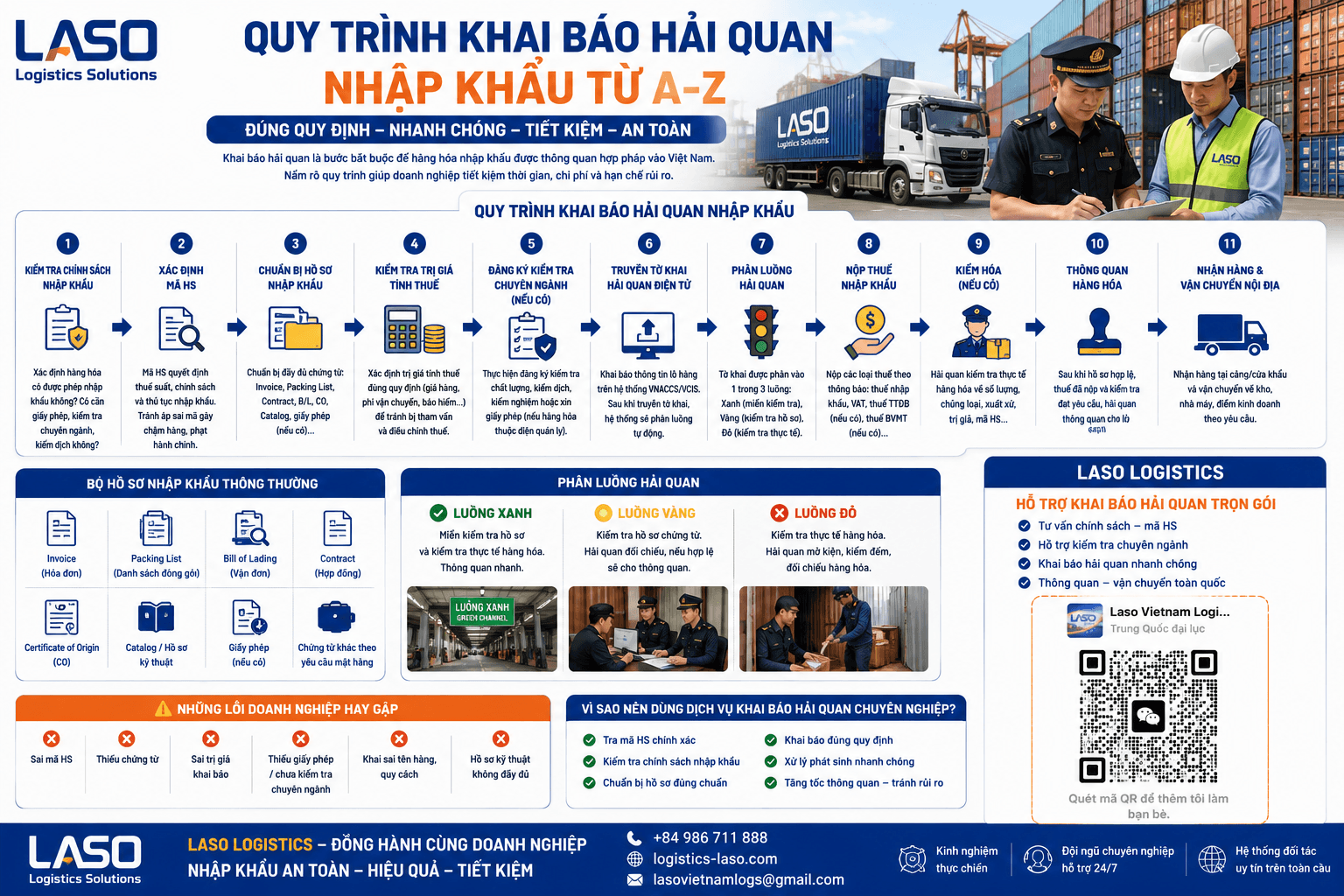
Latest A-Z Import Customs Declaration Process
Step 1: Check the Import Policy of the Goods
This is the most critical step but also the most common source of errors. Before the goods arrive, businesses need to determine:
- Are the goods permitted for import?
- Are they on the prohibited list?
- Is an import license required?
- Is specialized inspection required?
- Is quarantine necessary?
- Are there any special import conditions?
Example items that require attention:
- Cosmetics
- Foodstuffs
- Used machinery
- Medical devices
- Chemicals
- Lithium batteries
- Animal and plant products
Skipping this step carries very high risks.
Step 2: Determine the Correct HS Code
The HS Code dictates almost all import policies. It affects:
- Import duty
- VAT
- Specialized inspection requirements
- Management policies
- Import conditions
If the wrong HS code is applied:
- Incorrect tax calculation
- Incorrect documentation
- Rejection of the declaration by customs
- Administrative fines
- Cargo delays
This step must be performed with extreme care.
Step 3: Prepare the Import Document Set
A standard set of documents usually includes:
- Invoice (Commercial Invoice): Showing cargo value, seller, buyer, and delivery terms.
- Packing List: Including packing specifications, number of packages, weight, and dimensions.
- Contract (if applicable): Sales and purchase agreement.
- Bill of Lading / Transport documents: Depending on the mode of transport.
- Certificate of Origin (C/O): If tax incentives are requested.
- Catalog / Technical Documentation: Usually required for machinery, equipment, and electronics.
- Specialized Licenses (if applicable): For items like cosmetics, medical devices, or chemicals.
Step 4: Verify the Taxable Value
Customs will base tax calculations on the declared value. Businesses must determine:
- Purchase price
- Freight charges
- Insurance (if applicable)
- Delivery terms (FOB/CIF...)
Incorrect value declaration may lead to price consultation, tax adjustments, and clearance delays.
Step 5: Register for Specialized Inspection (if required)
If the goods are subject to management (Quality control, quarantine, testing, or licensing), this must be performed beforehand or concurrently. Failure to do so will prevent the goods from being cleared.
Step 6: Submit the Electronic Customs Declaration
After preparing all data, proceed with the declaration via the electronic system. After transmission, the system will categorize the declaration into a specific "channel."
Step 7: Customs Routing (Channeling)
After declaration, the entry will fall into one of the following channels:
- Green Channel: The fastest. Typically exempt from document and physical inspection. Only requires completion of tax obligations.
- Yellow Channel: Document inspection. Customs will review the Invoice, Packing List, C/O, and related documents. If compliant, the goods are cleared.
- Red Channel: Physical inspection of goods. This involves opening packages and verifying contents against the declaration. This channel is more time-consuming.
Step 8: Pay Import Taxes
Possible taxes include:
- Import duty
- VAT
- Special Consumption Tax (if applicable)
- Environmental Protection Tax (if applicable)
Goods are only eligible for clearance once tax obligations are fulfilled.
Step 9: Physical Inspection (if applicable)
In cases of Red Channel routing or suspicion, customs may physically inspect the type, quantity, condition, and HS code compliance of the goods.
Step 10: Customs Clearance
Once the documentation is valid, taxes are paid, and inspections meet requirements, customs authorizes clearance. The goods are then legally allowed to circulate.
Step 11: Cargo Receipt and Inland Transportation
After clearance, finalize the receipt of goods and coordinate transport to warehouses (e.g., Hanoi, Bac Ninh, Hai Phong, Ho Chi Minh City, Binh Duong).
Common Errors Encountered by Businesses
- Incorrect HS codes
- Missing documentation
- Incorrect declared value
- Missing licenses
- Failure to perform specialized inspections
- Incorrect goods description
- Incomplete technical documentation
Why Use Professional Customs Declaration Services?
Handling it in-house may save fees but carries high risks. A professional unit helps:
- Accurately determine HS codes
- Verify import policies
- Prepare standardized documentation
- Ensure compliance with regulations
- Handle unforeseen issues
- Accelerate the clearance process
Laso Logistics – Comprehensive Import Customs Declaration Services
Laso Logistics supports businesses from A to Z, including HS code lookup, policy verification, specialized inspection consulting, document preparation, customs declaration, and China-Vietnam transportation.
Contact Laso Logistics
Website: logistics-laso.com
Email: lasovietnamlogs@gmail.com
Hotline: +84 986 711 888
Laso Logistics – Fast, Legal, and Cost-Optimized Customs Clearance for Importers.