Requirements for Food Imports from China
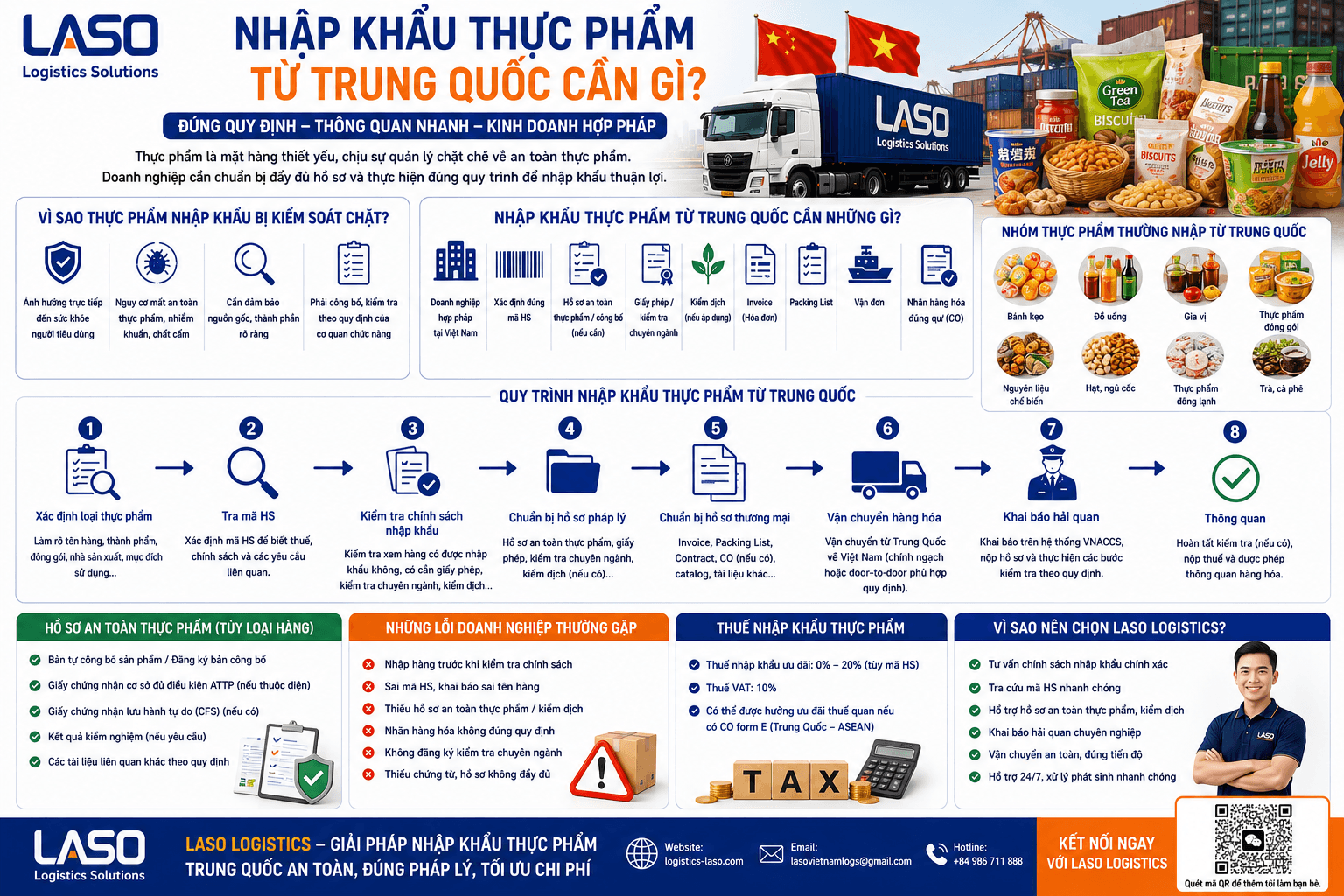
Food products are among the commodity groups imported from China to Vietnam with significant demand, ranging from production raw materials and packaged goods to retail consumer products. However, this category is subject to specialized management and strict controls regarding food safety, origin, and import procedures.
Many businesses encounter the following situations:
- Goods arriving at the border but failing customs clearance
- Missing food safety documentation
- Failing to register for specialized inspections
- Incorrect HS codes
- Product labels not meeting requirements
- Incurring significant demurrage and storage costs
So, what is required for importing food from China?
If your business is planning to import food, this article should be read carefully.
Is food from China allowed to be imported?
The answer is:
Yes.
However, not all types of food can be imported freely.
Importation depends on:
- The type of food
- Regulatory management policies
- Food safety regulations
- Quarantine requirements (if applicable)
- Legal documentation
Examples of common food groups:
- Confectionery
- Beverages
- Spices and seasonings
- Packaged food
- Processing materials
- Nuts and grains
- Fast food
- Tea
- Frozen food
- Food ingredients
Why is food strictly controlled?
Because food directly affects consumer health. Risks may include:
- Food safety hazards
- Bacterial contamination
- Presence of banned substances
- Incorrect ingredients
- Non-compliant labeling
- Unknown origin
Therefore, regulatory authorities exercise very close supervision.
What is required for importing food from China?
1. Valid Legal Entity
Usually required:
- A company registered in Vietnam
- Tax identification number
- Appropriate business functions
This is a basic requirement for formal commercial importation.
2. Accurate HS Code Identification
Each type of food has a different HS code. Examples include confectionery, tea, soft drinks, food ingredients, and spices. Incorrect HS codes lead to:
- Wrong tax rates
- Incorrect policy application
- Documentation errors
- Customs seizing the goods
3. Import Policy Verification
Not all food items are treated the same. You must check:
- If the item is permitted for import
- If a license is required
- If food safety inspection is mandatory
- If quarantine is required
- If the item is subject to restrictions
4. Food Safety Documentation
This is a critical component. Many food items must undergo food safety procedures before customs clearance, depending on the specific product.
5. Specialized Inspection
Many food items are subject to specialized inspection. This includes confectionery, beverages, processed foods, and packaged goods. Skipping this step often leads to goods being held.
6. Quarantine (If applicable)
If the food is of plant, animal, agricultural, seed, or biological origin, it may require quarantine.
7. Commercial Invoice
Must show the value of goods, seller, and buyer.
8. Packing List
Including number of packages, weight, and specifications.
9. Shipping Documents
Example: Bill of Lading.
10. Certificate of Origin (If necessary)
Used to prove origin and apply for preferential tax rates.
11. Product Labeling
Food labels are inspected very strictly. Required information usually includes:
- Product name
- Ingredients
- Manufacturer
- Origin
- Expiration date
- Storage instructions
- Warnings (if any)
12. Quality Records / Product Specifications
Depending on the type of food.
Import Process for Food from China
Step 1: Identify the food type (Ingredients, usage, packaging, origin).
Step 2: HS Code lookup (To determine taxes and specialized inspections).
Step 3: Check import policies.
Step 4: Prepare legal documentation (Food safety, quarantine, licenses).
Step 5: Prepare commercial documentation (Invoice, Packing List, Bill of Lading).
Step 6: Transportation (Formal import or door-to-door according to regulations).
Step 7: Customs declaration (Name of goods, HS code, value, specialized records).
Step 8: Customs clearance (After completing all inspections).
Common Mistakes by Businesses
- Importing goods before checking regulations
- Incorrect HS codes (invalidating the entire process)
- Missing food safety documentation
- Lack of quarantine records (if required)
- Non-compliant labeling
- Failing to verify policies in advance
Food Import Taxes
There is no fixed rate for all food items. It depends on the HS code, type of goods, origin, and Certificate of Origin (C/O).
Why use a professional logistics provider?
Food is a sensitive commodity group. An experienced provider will help:
- ✅ Accurately determine HS codes
- ✅ Verify import policies
- ✅ Advise on specialized inspections
- ✅ Support quarantine procedures
- ✅ Handle customs declarations
- ✅ Expedite customs clearance
LASO Logistics supports food imports from China
LASO Logistics provides:
- ✅ Import policy consultation
- ✅ HS code lookup
- ✅ Specialized inspection support
- ✅ Customs procedure assistance
- ✅ China – Vietnam transportation
- ✅ Compliant door-to-door solutions
Contact LASO Logistics
Website: logistics-laso.com
Email: lasovietnamlogs@gmail.com
Hotline: +84 986 711 888
LASO Logistics – Safe, legal, and cost-optimized food import solutions from China.