
Essential Considerations for Importing Machinery from China
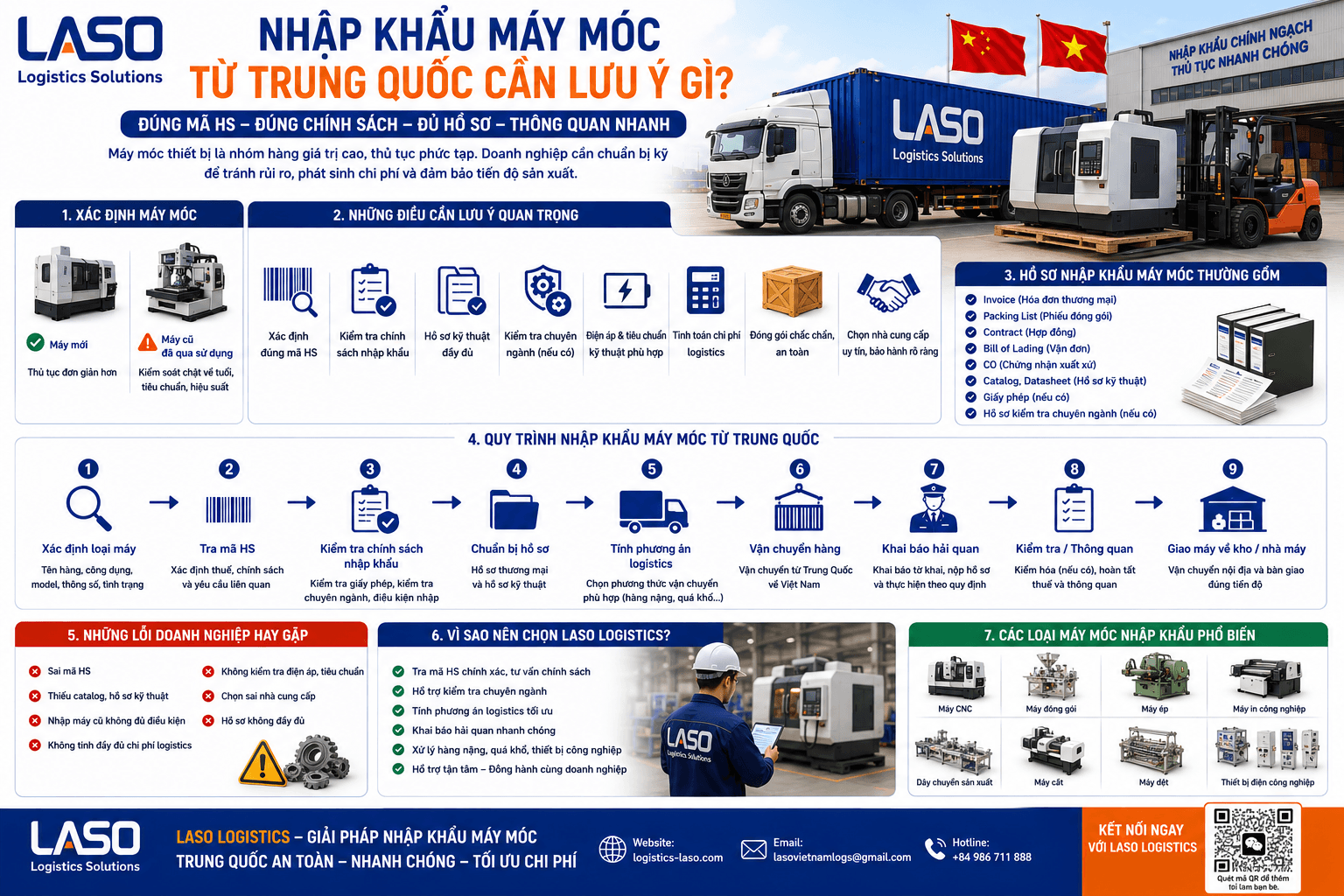
Machinery and industrial equipment are among the primary commodity groups imported by Vietnamese enterprises from China, driven by competitive pricing, extensive supply, and diverse manufacturing capabilities. From production lines and mechanical equipment to CNC machines and industrial electrical devices, China serves as a predominant source of supply.
<p>However, importing machinery is unlike handling standard consumer goods. This category often involves quality inspections, complex HS code classification, specialized regulatory procedures, and significant risks of cost overruns if preparation is inadequate.</p>
<p>Many enterprises encounter the following challenges:</p>
<ul>
<li>Shipments stalled at the border due to clearance issues</li>
<li>Incorrect HS codes leading to tax discrepancies</li>
<li>Missing technical documentation</li>
<li>Used machinery failing to meet import eligibility criteria</li>
<li>Increased physical inspections (customs examination)</li>
<li>Delays in production and installation schedules</li>
</ul>
<p><strong>What should you consider when importing machinery from China?</strong></p>
<h3>Why is Machinery Importation Particularly Sensitive?</h3>
<p>Unlike standard consumer goods, machinery is characterized by:</p>
<ul>
<li>High commercial value</li>
<li>Large dimensions and weight</li>
<li>Complex transportation requirements</li>
<li>Extensive technical documentation</li>
<li>Potential specialized inspection requirements</li>
<li>Technical certification needs</li>
<li>Special management by state authorities</li>
</ul>
<p>Even a minor error can result in substantial additional costs.</p>
<h3>Key Considerations When Importing Machinery from China</h3>
<h4>1. Determine if the Machinery is New or Used</h4>
<p>This is a critical factor.</p>
<p><strong>New Machinery:</strong> Procedures are generally more straightforward, but still require verification of import policies, taxes, and any applicable specialized inspections.</p>
<p><strong>Used/Second-hand Machinery:</strong> This is a high-risk category. Regulations may control the equipment's age, technical standards, performance efficiency, and specific import conditions. Not all used machinery is permitted for import.</p>
<h4>2. Accurate HS Code Classification</h4>
<p>This is the most crucial step. Each type of machine—whether CNC, packaging, printing, or textile machinery—has a specific HS code. Incorrect classification leads to tax errors, policy non-compliance, and customs delays.</p>
<h4>3. Verify Import Policies</h4>
<p>Check if the equipment is restricted, requires an import license, or is subject to quality and specialized inspections.</p>
<h4>4. Prepare Technical Documentation</h4>
<p>Machinery typically requires clear documentation, including Catalogs, Datasheets, Technical Specifications, Model/Serial numbers, Capacity, and Origin. These files facilitate HS code determination and customs clearance.</p>
<h4>5. Check Voltage and Technical Standards</h4>
<p>Ensure compatibility with Vietnam’s power grid (e.g., 220V/380V, 50Hz vs. 60Hz) and connection standards before purchase.</p>
<h4>6. Specialized Inspections</h4>
<p>Certain equipment, such as pressure vessels or specific industrial devices, must undergo quality testing, technical appraisal, or regulatory certification.</p>
<h4>7. Calculate Logistics Costs</h4>
<p>Machinery often incurs higher costs due to being heavy or oversized cargo, requiring specialized packaging, forklifts, cranes, or specialized containers.</p>
<h4>8. Packaging Methods</h4>
<p>To prevent damage to electronic components or mechanical parts, ensure the use of wooden crates, shockproofing, moisture protection, and frame reinforcement.</p>
<h4>9. Warranty and Technical Support</h4>
<p>Clarify technical support policies, availability of spare parts, and response times for equipment in Vietnam.</p>
<h4>10. Supplier Verification</h4>
<p>Verify the manufacturer's credibility, production quality, and ability to provide necessary documentation.</p>
<h3>Common Import Documentation</h3>
<p>Typically includes: Invoice, Packing List, Contract, Bill of Lading, Certificate of Origin (CO), Catalog/Datasheet, and specialized permits or inspection results.</p>
<h3>The Machinery Import Process from China</h3>
<ol>
<li><strong>Identify Equipment Details:</strong> Name, function, model, specs, and condition (new/used).</li>
<li><strong>HS Code Determination:</strong> Essential for tax and policy mapping.</li>
<li><strong>Policy Review:</strong> To avoid non-compliant purchases.</li>
<li><strong>Document Preparation:</strong> Commercial and technical files.</li>
<li><strong>Logistics Planning:</strong> Choosing between trucks, containers, or Flat Racks for oversized cargo.</li>
<li><strong>Transportation:</strong> China – Vietnam route.</li>
<li><strong>Customs Declaration:</strong> Submission of technical profiles.</li>
<li><strong>Inspection/Clearance:</strong> Handling physical inspections if required.</li>
<li><strong>Final Delivery:</strong> Coordination for factory unloading and installation.</li>
</ol>
<h3>Why Choose a Professional Logistics Provider?</h3>
<p>Machinery is a high-value asset. An experienced partner helps with accurate HS coding, policy consulting, specialized inspections, and safe transport coordination for heavy and oversized cargo.</p>
<p><strong>Laso Logistics – Safe, Fast, and Optimized Machinery Import Solutions.</strong></p>
<p><strong>Contact Laso Logistics:</strong><br>Website: logistics-laso.com<br>Email: lasovietnamlogs@gmail.com<br>Hotline: +84 986 711 888</p>