What is Customs Physical Inspection?
In import-export activities, particularly when importing goods from China to Vietnam, many businesses are most concerned when they hear the phrase “customs physical inspection.” This is the step that can cause shipments to take additional processing time, incur extra costs, and directly impact the delivery schedule.
<p>Many businesses encounter these situations:</p>
<ul>
<li>Goods have arrived at the border gate but have not been cleared.</li>
<li>Customs requires opening the packages for inspection.</li>
<li>Incurring handling and storage costs.</li>
<li>Delays in delivery schedules.</li>
<li>Requirements to provide explanations for the documentation.</li>
</ul>
<p>So, what is customs physical inspection? When are goods inspected? How does the process take place? If your business is importing goods, this is essential information to understand clearly.</p>
<h3>What is Customs Physical Inspection?</h3>
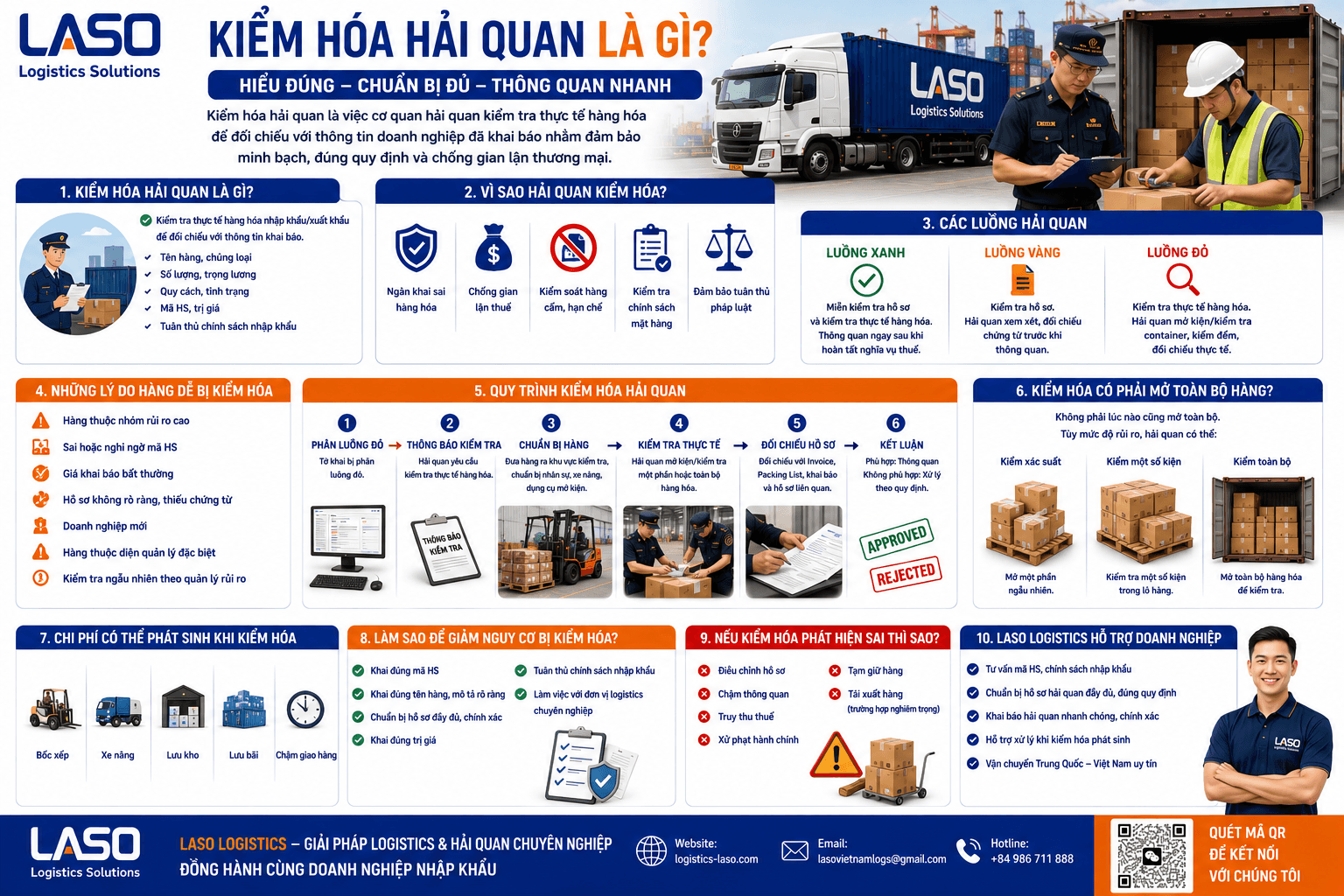
<p>Customs physical inspection is the process where customs authorities physically examine imported or exported goods to compare them with the information declared by the business. The purpose is to verify:</p>
<ul>
<li>Is the declared commodity name correct?</li>
<li>Type of goods.</li>
<li>Actual quantity.</li>
<li>Weight.</li>
<li>Specifications of goods.</li>
<li>Condition of goods.</li>
<li>Declared HS Code.</li>
<li>Declared value (in some cases).</li>
<li>Compliance with import policies.</li>
</ul>
<p>Simply put: Customs opens and inspects the actual goods to see if the business's declaration is accurate.</p>
<h3>Why does Customs conduct inspections?</h3>
<p>Physical inspection ensures:</p>
<p><strong>Prevention of misdeclaration:</strong> For example, declaring low-value goods when they are actually high-value items.</p>
<p><strong>Prevention of tax fraud:</strong> Incorrect HS codes can lead to incorrect tax payments.</p>
<p><strong>Control of prohibited/restricted goods:</strong> For example:</p>
<ul>
<li>Counterfeit goods.</li>
<li>Prohibited imports.</li>
<li>Goods requiring special permits.</li>
</ul>
<p><strong>Checking commodity policies:</strong> For example:</p>
<ul>
<li>Goods requiring quarantine.</li>
<li>Goods requiring specialized inspections.</li>
</ul>
<p><strong>Ensuring legal compliance:</strong> Reducing risks of smuggling or commercial fraud.</p>
<h3>When are goods subject to physical inspection?</h3>
<p>Not every shipment is inspected. This depends on the customs channeling result.</p>
<h4>Customs Channels</h4>
<p><strong>Green Channel:</strong> This is the most favorable case. Typically:</p>
<ul>
<li>No deep document inspection.</li>
<li>No physical inspection of goods.</li>
<li>Only need to complete tax obligations and clearance.</li>
</ul>
<p><strong>Yellow Channel:</strong> Document inspection. Customs will review:</p>
<ul>
<li>Invoice</li>
<li>Packing List</li>
<li>C/O (Certificate of Origin)</li>
<li>Technical dossiers</li>
<li>Licenses</li>
</ul>
<p>Usually, the physical goods do not need to be opened yet.</p>
<p><strong>Red Channel:</strong> This is the case for physical inspection. Actions may include:</p>
<ul>
<li>Opening packages.</li>
<li>Inspecting the container.</li>
<li>Counting goods.</li>
<li>Checking types.</li>
</ul>
<p>The Red Channel is what businesses worry about the most.</p>
<h3>Reasons why goods are easily flagged for inspection</h3>
<ol>
<li><strong>High-risk product groups:</strong> E.g., cosmetics, food, chemicals, machinery, electrical equipment, lithium batteries, high-value goods.</li>
<li><strong>Incorrect or suspicious HS Codes:</strong> If customs suspects the HS code is inaccurate.</li>
<li><strong>Abnormal declared value:</strong> E.g., declaring a price much lower than reality.</li>
<li><strong>Unclear documentation:</strong> E.g., missing documents, unclear catalogs, or incorrect descriptions.</li>
<li><strong>New businesses:</strong> New importers may be subject to stricter scrutiny.</li>
<li><strong>Goods under special management:</strong> E.g., goods requiring quarantine, specialized inspection, or licenses.</li>
<li><strong>Random inspection:</strong> Some shipments are selected for inspection based on risk management systems.</li>
</ol>
<h3>What is the customs physical inspection process?</h3>
<p><strong>Step 1:</strong> Declaration is flagged for the Red Channel after electronic filing.</p>
<p><strong>Step 2:</strong> Customs requests a physical inspection; the business receives notification.</p>
<p><strong>Step 3:</strong> Prepare goods for inspection. This may involve moving goods to the inspection area and preparing personnel or forklifts to open packages.</p>
<p><strong>Step 4:</strong> Customs conducts the inspection (may check a portion, the whole shipment, or check by probability).</p>
<p><strong>Step 5:</strong> Compare with documentation (Invoice, Packing List, declaration, technical files).</p>
<p><strong>Step 6:</strong> Conclusion. If compliant, clearance is granted. If incorrect, further processing is required.</p>
<h3>Does inspection require opening all goods?</h3>
<p>Not always. It can be:</p>
<ul>
<li><strong>Probability check:</strong> Opening a portion.</li>
<li><strong>Checking specific packages:</strong> Depending on the risk assessment.</li>
<li><strong>Full inspection:</strong> If there is high suspicion.</li>
</ul>
<h3>How long does the inspection take?</h3>
<p>There is no fixed time. It depends on the type of goods, shipment size, documentation, complexity, and whether HS code disputes arise. It could take a few hours, a day, or several days if issues occur.</p>
<h3>Potential costs arising during inspection</h3>
<p>Businesses may incur: handling fees, forklift fees, transport within the port, storage fees, demurrage, and delivery delays. For heavy goods or large containers, costs can be significant.</p>
<h3>How to reduce the risk of physical inspection?</h3>
<ul>
<li><strong>Declare correct HS codes:</strong> Most important.</li>
<li><strong>Declare accurate item names:</strong> Avoid vague descriptions.</li>
<li><strong>Prepare complete documentation:</strong> Invoice, Packing List, Catalog, C/O, Licenses.</li>
<li><strong>Declare correct value:</strong> Do not declare unusually low prices.</li>
<li><strong>Comply with import policies:</strong> Such as quarantine or specialized inspections.</li>
<li><strong>Work with professional logistics providers:</strong> Reduces risks significantly.</li>
</ul>
<h3>What happens if the inspection finds errors?</h3>
<p>Possible outcomes: adjustment of documents, delayed clearance, tax arrears, administrative fines, seizure of goods, or re-export (in serious cases).</p>
<h3>Why should businesses use professional logistics services?</h3>
<p>Experienced units help: Verify standard HS codes, check policies before importing, prepare correct documentation, minimize Red Channel risks, support handling if inspections occur, and reduce delays.</p>
<h3>Laso Logistics supports declaration & customs physical inspection handling</h3>
<p>Laso Logistics provides support for:</p>
<ul>
<li>HS code lookup.</li>
<li>Import policy consultation.</li>
<li>Customs documentation preparation.</li>
<li>Full customs declaration services.</li>
<li>Inspection handling support.</li>
<li>China – Vietnam transportation.</li>
</ul>
<p><strong>Contact Laso Logistics</strong></p>
<p>Website: logistics-laso.com<br>Email: lasovietnamlogs@gmail.com<br>Hotline: +84 986 711 888</p>
<p><strong>Laso Logistics – Professional logistics & customs solutions for importers.</strong></p>