When is Specialized Inspection Required for Imported Goods?
In import-export activities, specialized inspection is one of the primary issues causing businesses to lose time, incur costs, and experience delays. Many cases involve goods arriving at the border that cannot be cleared due to incomplete regulatory specialized inspection procedures.
What is Specialized Inspection?
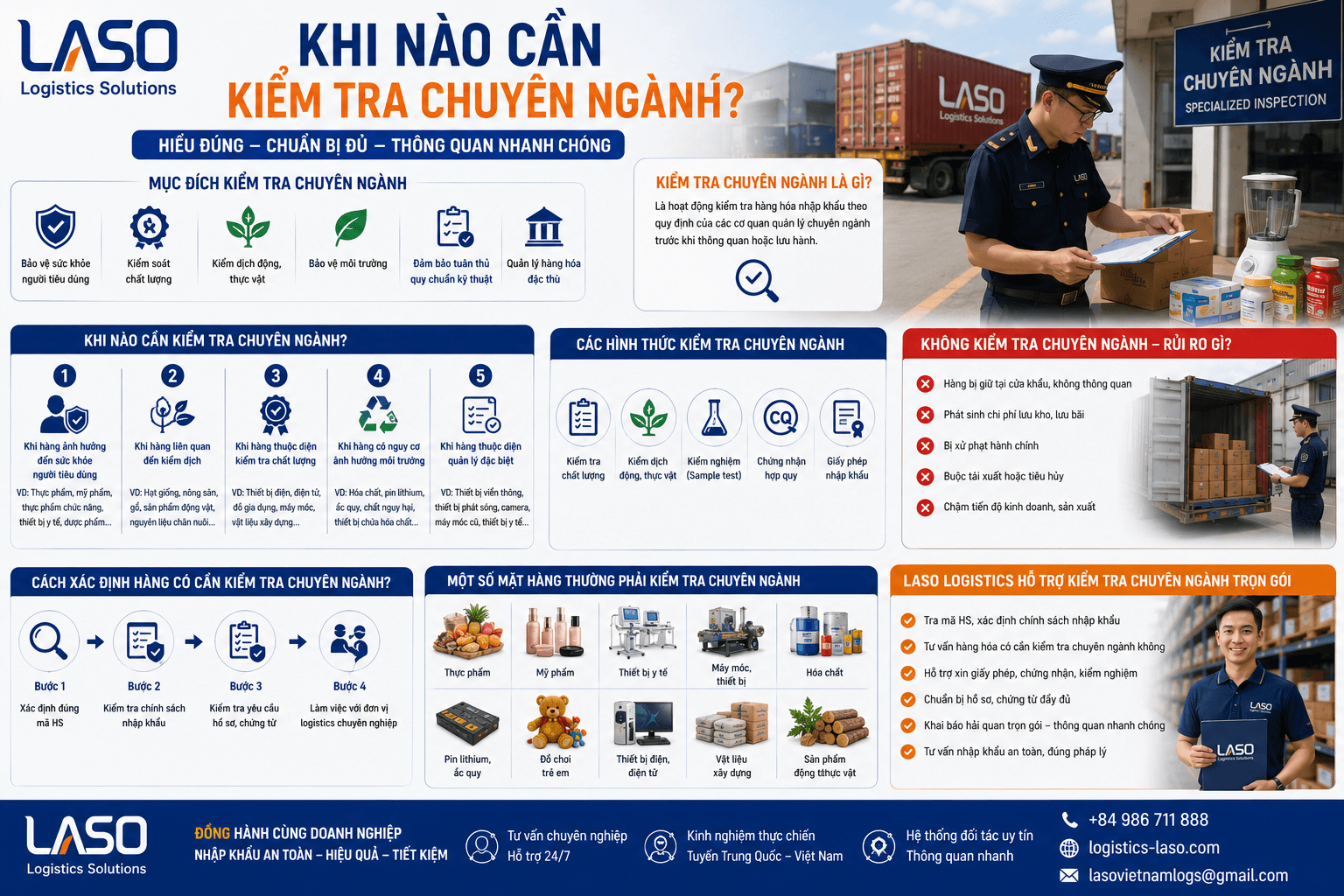
Specialized inspection refers to the activity of inspecting imported goods in accordance with the regulations of specialized state management agencies before they are permitted for customs clearance or circulation.
The purpose is to control:
- Product quality
- Consumer safety
- Disease risks
- Environmental impacts
- Compliance with technical standards
- Control of specific goods
Unlike standard customs inspections, specialized inspections involve specific specialized agencies.
For example:
- Ministry of Health
- Ministry of Industry and Trade
- Ministry of Agriculture and Rural Development
- Ministry of Science and Technology
- Ministry of Information and Communications
- Designated inspection agencies
When do goods require specialized inspection?
Not every shipment requires inspection.
Typically, businesses need specialized inspection when goods belong to a special management group.
1. When goods affect consumer health
Products in direct contact with users are usually strictly controlled.
Examples:
- Food
- Beverages
- Functional foods
- Cosmetics
- Medical devices
- Pharmaceuticals (subject to specific regulations)
These groups may require:
- Testing
- Product declaration
- Quality dossiers
- Import licenses
2. When goods involve quarantine
If goods contain biological elements, plants, animals, or disease risks, quarantine is usually mandatory.
Examples:
Plant Quarantine
Applied to:
- Seeds
- Wood
- Agricultural products
- Vegetables
- Plant-based raw materials
Animal Quarantine
Applied to:
- Animal products
- Hides, fur
- Animal feed ingredients
- Certain production raw materials
3. When goods are subject to quality inspection
Many items must undergo quality standard checks before circulation.
Examples:
- Electrical equipment
- Electronics
- Household appliances
- Machinery
- Industrial equipment
- Construction materials
- Safety devices
Requirements may include:
- Conformity certification
- Technical inspection
- Standard documentation
4. When goods pose environmental risks
Certain groups of goods require environmental control.
Examples:
- Chemicals
- Lithium batteries
- Accumulators
- Hazardous substances
- Equipment containing chemicals
5. When goods are under special specialized management
Some products, though not common, fall under specific control categories.
Examples:
- Broadcasting equipment
- Telecommunications devices
- Specialized cameras
- Medical equipment
- Industrial chemicals
- Used machinery
- Security equipment
Common items requiring specialized inspection when imported from China
Groups frequently encountered by businesses:
- Cosmetics
- Food
- Functional foods
- Medical devices
- Machinery
- Electrical equipment
- Chemicals
- Lithium batteries
- Children's toys
- Broadcasting equipment
- Construction materials
- Animal and plant products
What are the forms of specialized inspection?
Depending on the type of goods, various forms may be applied.
- Quality Inspection: Checking technical standards.
- Quarantine: Applied to plants and animals.
- Testing/Analysis: Common for food, cosmetics, and chemicals.
- Conformity Certification: Applied to equipment with technical requirements.
- Applying for Import Licenses: Certain goods must have a license before import.
What happens if specialized inspection is skipped?
The risks are significant.
Businesses may face:
- Goods being held at the border
- Failure to clear customs
- Incurred storage costs (demurrage/detention)
- Administrative fines
- Forced re-export
- Delivery delays
- Impact on production plans
Many businesses lose tens of millions of VND simply because they did not conduct prior inspections.
How to determine if goods require specialized inspection
Businesses should check before placing an order.
Steps:
1. Determine the correct HS Code: This is the most critical step. Wrong HS code = wrong import policy.
2. Check commodity policies: Verify if it falls under management, requires a license, or needs quarantine.
3. Check documentation requirements: For example: Invoice, Packing list, CO, CQ, Catalog, Technical dossiers, MSDS.
4. Work with an experienced logistics provider: This significantly reduces errors.
Why do businesses often experience delays at this stage?
Common errors:
- Incorrect HS codes
- Purchasing goods before checking policies
- Missing documentation
- Failure to apply for licenses
- Lack of prepared technical dossiers
- Incorrect commodity declaration
Laso Logistics provides full-service specialized inspection support
If your business is unsure whether your goods require specialized inspection, Laso Logistics offers:
✅ HS Code lookup
✅ Import policy verification
✅ Determination of specialized inspection requirements
✅ Documentation support
✅ Comprehensive customs declaration
✅ Safe import consultation from China
Laso Logistics – Partnering with businesses for fast, legally compliant customs clearance.
Specialized inspection is a step that can delay a shipment for many days if prepared incorrectly. Do not wait until the goods arrive at the border to discover missing procedures.
Website: logistics-laso.com
Email: lasovietnamlogs@gmail.com
Hotline: +84 986 711 888
Laso Logistics – Professional logistics & customs solutions for importing businesses.