Differences Between Informal and Formal Trade: Which Should Businesses Choose for China Imports?
In import-export activities between Vietnam and China, the concepts of informal trade and formal trade are frequently mentioned. Many businesses, especially those new to the field, often hesitate between these two methods to balance cost savings with legal security.
<p>In reality, each method has its own advantages and limitations. Choosing correctly helps businesses optimize time and costs while minimizing risks during the transportation process.</p>
<h3>What is Informal Trade?</h3>
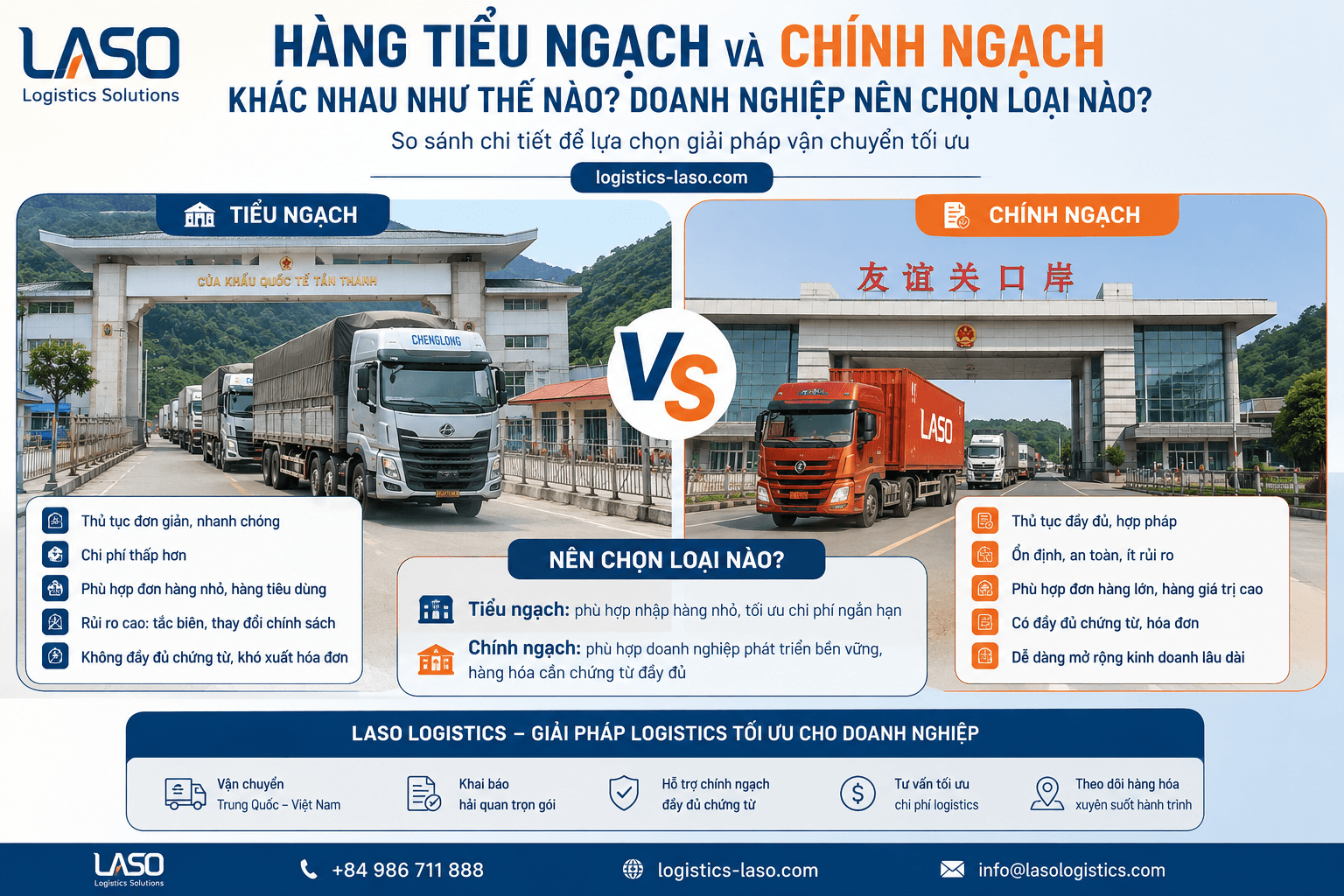
<p>Informal trade (cross-border trade) refers to small-scale goods exchange across borders, often via auxiliary border gates, border openings, or through border resident exchange programs. This method was traditionally favored by individuals and small business households due to simple procedures and low initial costs.</p>
<p><strong>Characteristics of informal trade:</strong></p>
<ul>
<li>Faster processing procedures.</li>
<li>Does not require a full set of documents like formal trade in certain cases.</li>
<li>Shipping costs may be lower at specific times.</li>
<li>Suitable for small orders and general consumer goods.</li>
</ul>
<p><strong>However, informal trade carries many risks:</strong></p>
<ul>
<li>Risk of border congestion and cargo delays.</li>
<li>Sudden policy changes.</li>
<li>Difficulty in controlling delivery schedules.</li>
<li>Instability for businesses requiring long-term planning.</li>
<li>Difficulty in proving valid proof of origin.</li>
<li>Limitations on issuing full invoices and documentation.</li>
</ul>
<p>For businesses requiring stable imports, informal trade is often not a sustainable choice.</p>
<h3>What is Formal Trade?</h3>
<p>Formal trade is the official import-export method following the customs regulations of both countries, featuring full dossiers, documentation, tax declarations, and customs clearance procedures. This is the preferred method for professional import-export enterprises.</p>
<p><strong>Characteristics of formal trade:</strong></p>
<ul>
<li>Clear purchase contracts.</li>
<li>Invoices, packing lists, and certificates of origin provided as needed.</li>
<li>Full customs declarations.</li>
<li>Transparent invoices and documentation.</li>
<li>Legally controlled cargo.</li>
<li>Easy traceability and verification of origin.</li>
</ul>
<p><strong>Formal trade is suitable for:</strong></p>
<ul>
<li>Businesses importing large volumes.</li>
<li>High-value cargo.</li>
<li>Goods requiring specialized inspection and testing.</li>
<li>Goods requiring VAT invoices.</li>
<li>Long-term production and business operations.</li>
</ul>
<h3>Comparison of Informal and Formal Trade</h3>
<p><strong>1. Legal Standing</strong><br>Informal: Lower legal security, highly dependent on border policies at specific times.<br>Formal: Fully legal and transparent, suitable for official business operations.</p>
<p><strong>2. Cost</strong><br>Informal: May be cheaper in the short term.<br>Formal: Initial costs may be higher due to taxes, customs fees, and documentation. However, in the long run, formal trade helps businesses avoid major expenses arising from delays or legal risks.</p>
<p><strong>3. Delivery Time</strong><br>Informal: Fast when customs clearance is smooth, but prone to delays if border checks are tightened.<br>Formal: Stable and easier for delivery planning.</p>
<p><strong>4. Business Scalability</strong><br>Informal: Difficult to scale up.<br>Formal: Suitable for long-term business development.</p>
<p><strong>5. Cargo Safety</strong><br>Informal: Risks of loss, congestion, and forced changes in transport routes.<br>Formal: Better control processes and higher safety.</p>
<h3>Which Method Should Businesses Choose?</h3>
<p>There is no one-size-fits-all answer for every business.</p>
<p><strong>Choose informal trade if:</strong><br>- You import small quantities.<br>- General consumer goods.<br>- No requirement for complex documentation.<br>- Goal is short-term cost optimization.</p>
<p><strong>Choose formal trade if:</strong><br>- Professional import enterprise.<br>- Large cargo volumes.<br>- High-value goods.<br>- Need for VAT invoices.<br>- Need to prove cargo origin.<br>- Aim for sustainable development.</p>
<p>In the current climate, regulatory authorities are increasingly tightening border trade controls. Therefore, formal trade is becoming the safer and more sustainable direction for businesses.</p>
<h3>Laso Logistics Supports Informal & Formal Shipping Vietnam – China</h3>
<p>If your business is unsure which option suits your cargo, the Laso Logistics team can provide consulting for optimal solutions based on your actual needs:</p>
<ul>
<li>✅ China – Vietnam Transportation</li>
<li>✅ All-inclusive customs declaration</li>
<li>✅ Formal trade support with full documentation</li>
<li>✅ Logistics cost optimization consulting</li>
<li>✅ End-to-end cargo tracking</li>
</ul>
<p><strong>Laso Logistics – Optimal logistics solutions for import-export enterprises.</strong></p>
<p>📞 Contact Laso Logistics<br>📞 Hotline: +84986711888<br>🌐 Website: logistics-laso.com<br>📍 Phu Loc Urban Area, Dong Kinh Ward, Lang Son Province</p>
<p>👉 Inbox now for a free consultation on the most suitable import method.</p>