
What is the Difference Between LCL and FCL Shipping?
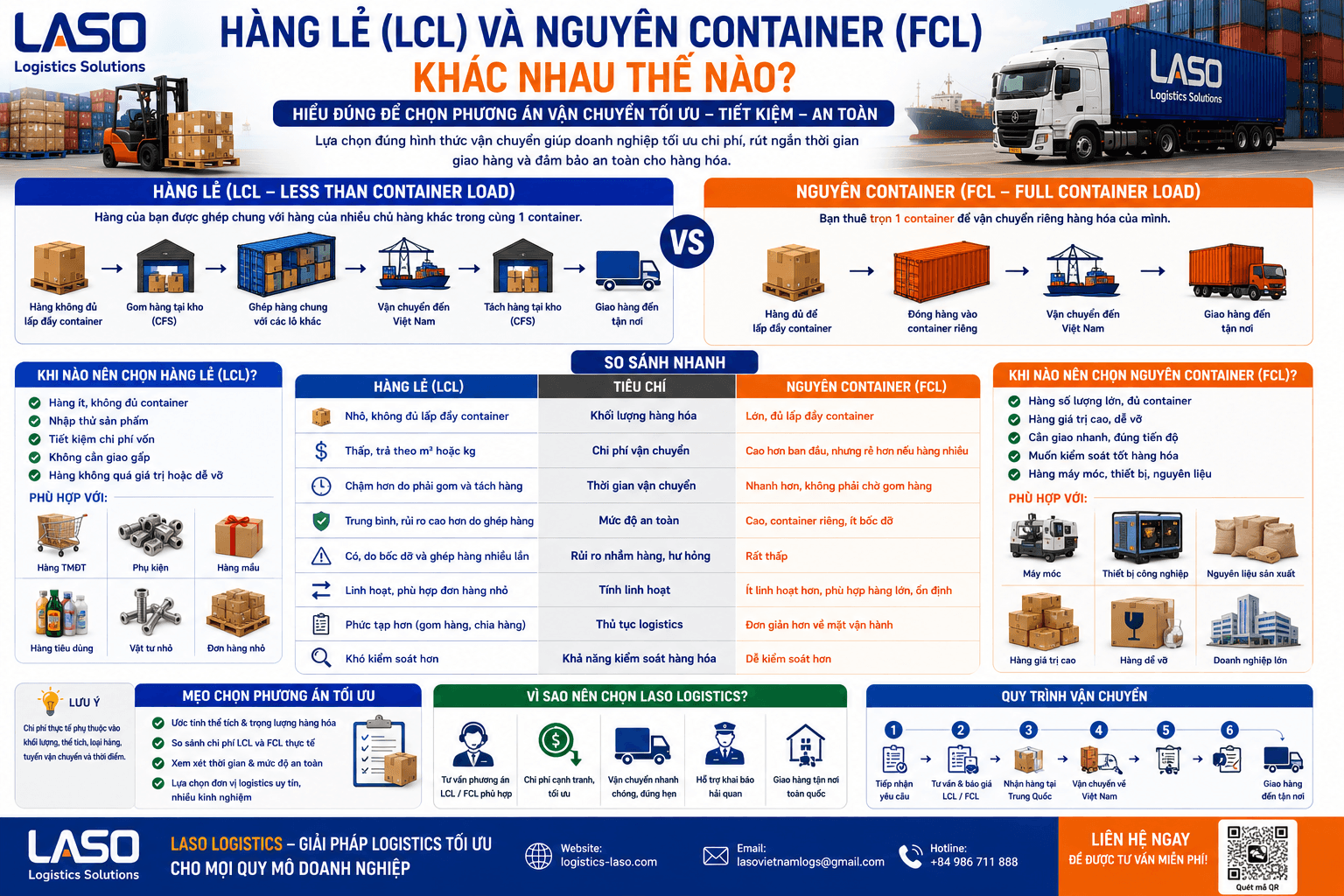
In international import-export and logistics activities, businesses frequently encounter two common modes of transport: Less than Container Load (LCL) and Full Container Load (FCL).
Many new businesses importing cargo from China often wonder:<br><br>
Should they choose LCL or FCL?<br>
Which option is more cost-effective?<br>
Which method is faster?<br>
Which is safer for the goods?<br>
When should FCL be chosen over LCL?<br><br>
Choosing the wrong shipping method can lead to:<br>
- Significantly increased logistics costs<br>
- Delayed delivery times<br>
- Incurred storage fees<br>
- Risk of cargo damage<br>
- Reduced operational efficiency<br><br>
So, what are the differences between LCL and FCL?<br><br>
<b>What is Less than Container Load (LCL)?</b><br>
LCL (Less than Container Load) is a shipping method used when a business's cargo volume is insufficient to fill an entire container, requiring it to be consolidated with shipments from other shippers.<br><br>
Simply put:<br>
You only book the specific container space that you need.<br><br>
Examples:<br>
- 2m³ of cargo<br>
- 5m³ of cargo<br>
- 10m³ of cargo<br>
The goods will be consolidated into a single container with various other shipments.<br><br>
<b>What is Full Container Load (FCL)?</b><br>
FCL (Full Container Load) is a method where a business charters an entire container exclusively for their own cargo.<br>
Regardless of whether the container is filled to capacity, it remains dedicated to a single shipper.<br><br>
Examples:<br>
- 20-foot container<br>
- 40-foot container<br>
- 40HC container<br>
The entire container is utilized exclusively for the business's shipment.<br><br>
<b>Key Differences Between LCL and FCL</b><br><br>
<b>1. Cargo Volume</b><br>
<b>LCL:</b> Suitable for low volumes, shipments that do not fill a container, small orders, or market testing. Examples: A few packages, several pallets, small quantity goods.<br>
<b>FCL:</b> Suitable for high volumes, regular order cycles, or when dedicated transport is required. Examples: Full 20ft/40ft container loads, mass-produced goods.<br><br>
<b>2. Shipping Costs</b><br>
<b>LCL:</b> Advantage: You do not have to pay for the entire container. You are billed based on: CBM (cubic meters), weight (kg), or volumetric weight. Suitable for small shipments. Disadvantage: The unit price per volume can be higher.<br>
<b>FCL:</b> The initial container rental cost is higher. However, for large volumes, the unit cost per item is typically lower. For example: 1–2 pallets → LCL is more logical; a nearly full container → FCL is more economical.<br><br>
<b>3. Transit Time</b><br>
<b>LCL:</b> Usually slower due to the consolidation process, waiting for the container to fill, and deconsolidation (sorting) at the destination.<br>
<b>FCL:</b> Faster because there is no waiting for consolidation or sorting. It is handled directly, making it ideal for urgent shipments.<br><br>
<b>4. Cargo Safety</b><br>
<b>LCL:</b> Higher risk because goods are consolidated with other shippers, handled multiple times, and moved through various stages. Potential risks include impact, misplacement, or scratching.<br>
<b>FCL:</b> Safer as it involves a dedicated container with minimal handling and no contact with other types of cargo. Highly recommended for: Machinery, equipment, fragile items, and high-value cargo.<br><br>
<b>5. Flexibility</b><br>
<b>LCL:</b> More flexible for small and medium enterprises (SMEs) as it avoids the need for bulk imports or maintaining high inventory levels.<br>
<b>FCL:</b> Requires more intensive cargo planning. Best for businesses with stable demand.<br><br>
<b>6. Logistics Procedures</b><br>
<b>LCL:</b> Involves additional steps such as consolidation, deconsolidation, and managing multiple shippers per container, making the process more complex.<br>
<b>FCL:</b> Simpler operational workflow.<br><br>
<b>7. Cargo Control</b><br>
<b>LCL:</b> Harder to control since multiple shipments share one container.<br>
<b>FCL:</b> Easier to control as all goods belong to one owner.<br><br>
<b>Quick Comparison: LCL vs FCL</b><br>
| Criteria | LCL | FCL |<br>
| --- | --- | --- |<br>
| Cargo Volume | Small | Large |<br>
| Initial Cost | Low | High |<br>
| Unit Cost | Higher | Lower for large volumes |<br>
| Speed | Slower | Faster |<br>
| Safety | Moderate | High |<br>
| Risk of Error | Present | Very Low |<br>
| Suitability | SME / Trial imports | Large Enterprises |<br><br>
<b>When to choose LCL?</b><br>
✅ Small cargo volume<br>
✅ Capital preservation<br>
✅ Product testing<br>
✅ Insufficient volume for a full container<br>
✅ Non-urgent shipments<br>
Examples: E-commerce goods, accessories, samples, market trials.<br><br>
<b>When to choose FCL?</b><br>
✅ Large cargo volume<br>
✅ Urgent delivery required<br>
✅ High-value goods<br>
✅ Fragile items<br>
✅ Enhanced control needed<br>
Examples: Machinery, equipment, raw production materials, large-scale enterprise cargo.<br><br>
<b>Choosing Between LCL and FCL for China Imports</b><br>
There is no single best solution for every business. If the cargo is minimal → LCL is more logical. If the volume is high → FCL is more cost-effective. If the cargo is urgent → FCL is usually faster. If the goods are fragile → FCL is safer.<br><br>
<b>Why Use a Professional Logistics Provider?</b><br>
An incorrect choice can result in significant costs. A professional logistics partner helps:<br>
✅ Calculate actual costs<br>
✅ Advise on LCL/FCL suitability<br>
✅ Optimize shipping routes<br>
✅ Reduce incidental logistics expenses<br>
✅ Support customs clearance<br>
✅ Provide door-to-door delivery<br><br>
<b>Laso Logistics Supports LCL & FCL Shipping Between China and Vietnam</b><br>
Laso Logistics provides:<br>
✅ China LCL consolidation<br>
✅ FCL container shipping<br>
✅ Door-to-door services<br>
✅ Customs declaration<br>
✅ China – Vietnam transit<br>
✅ Nationwide delivery<br><br>
<b>Contact Laso Logistics</b><br>
Website: logistics-laso.com<br>
Email: lasovietnamlogs@gmail.com<br>
Hotline: +84 986 711 888<br><br>
Laso Logistics – Optimal logistics solutions for businesses of all scales.