Dong Dang Station - Lang Son and the Advantages of Railway Transport
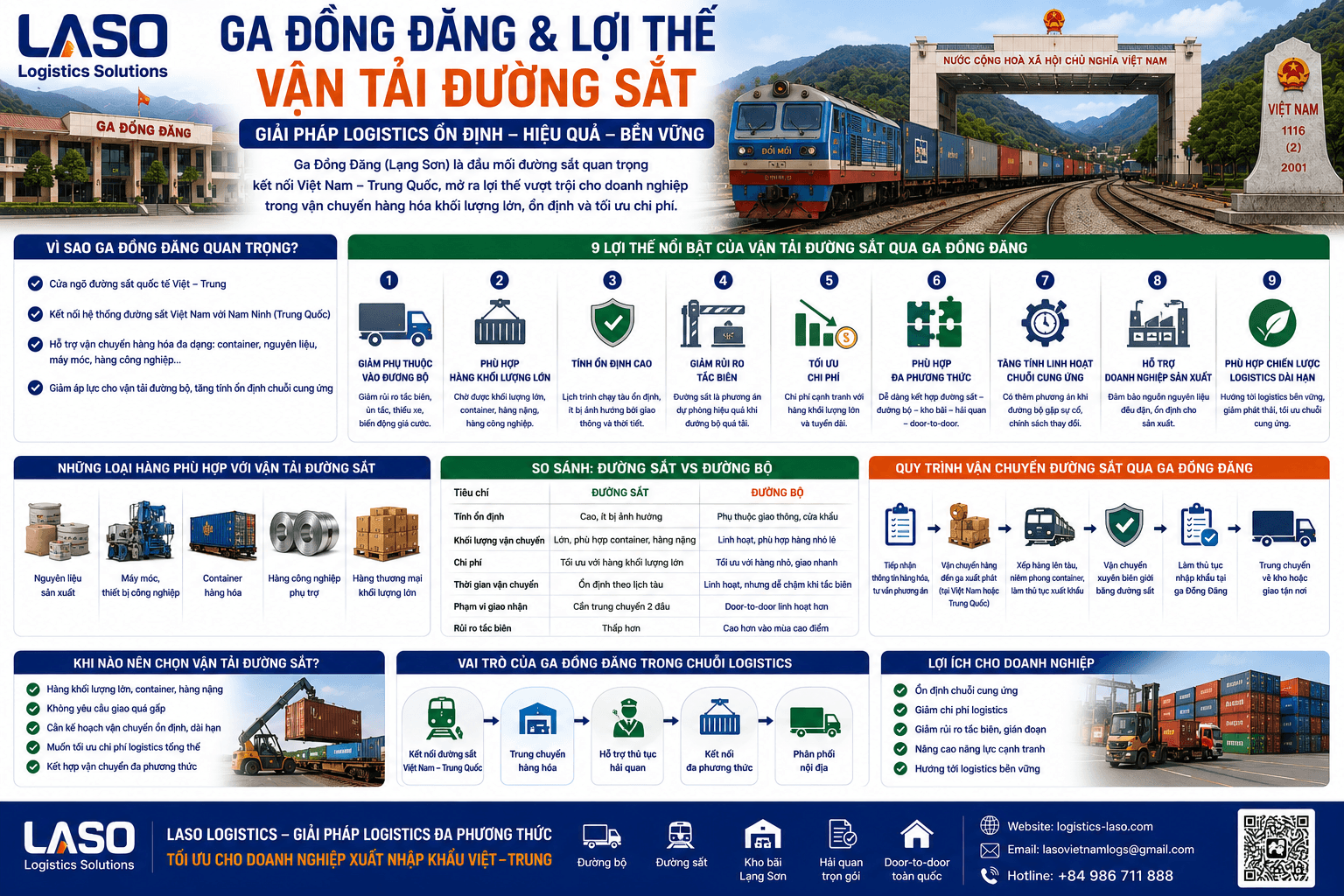
In Vietnam–China logistics operations, when discussing cross-border shipping, most businesses immediately think of road transport via border gates such as Huu Nghi, Tan Thanh, or Chi Ma. However, Dong Dang Station (Lang Son) is increasingly becoming a strategic link in the logistics chain thanks to its advantages in cross-border railway transport.
In a context where businesses need to:
Reduce logistics costs
Optimize the supply chain
Limit border congestion risks
Ensure stable shipping schedules
Have more options beyond road transport
railway transport via Dong Dang Station is an option worth considering.
So, what is the role of Dong Dang Station and why is railway transport becoming increasingly important?
**What is Dong Dang Station?**
Dong Dang Station is located in Lang Son, near the Vietnam–China border area.
It is a vital railway hub in the route connecting Vietnam with China and the regional logistics network.
The station plays a role in:
Transshipment of goods
Connecting cross-border transport
Supporting multimodal logistics
Reducing pressure on road transport
**Why is Dong Dang Station Important?**
Lang Son is the largest logistics center on the Vietnam–China route.
While:
Huu Nghi is strong in road transport
Tan Thanh is strong in certain commodity groups
Chi Ma supports load distribution
Dong Dang opens up advantages in railway logistics.
This helps make the supply chain more flexible.
**What is Railway Transport?**
This is the form of transporting goods by train.
Suitable for:
Containers
Raw materials
Machinery
Industrial goods
High volumes
Cross-border routes
Compared to road transport:
Railway has many unique advantages.
**Advantages of Dong Dang Station and Railway Transport**
1. **Reduced Dependence on Road Transport**
This is a massive advantage. Many businesses currently depend heavily on trucks.
Risks include:
Border congestion
Truck shortages
Fluctuating freight rates
Peak hour gridlock
Railway helps reduce this dependence.
2. **Suitable for High-Volume Cargo**
If a business transports:
Containers
Heavy goods
Production raw materials
Industrial equipment
then railway is very suitable. It has high carrying capacity.
3. **Higher Stability**
Road vehicles depend on:
Traffic
Border gate conditions
Vehicle dispatching
Peak periods
Railway is usually more stable in terms of scheduling. This is crucial for the supply chain.
4. **Reduced Risk of Border Congestion**
Border congestion is a major issue in Vietnam–China logistics, especially during peak seasons. Railway provides businesses with an additional solution.
5. **Cost Optimization for Certain Cargo Types**
Not every type of cargo is cheaper by rail. But for:
Large shipments
High volumes
Stable cargo flows
railway can provide excellent optimization.
6. **Suitable for Multimodal Logistics**
Modern logistics trends involve using more than just one route. One can combine:
Rail
Road
Warehousing
Door-to-door
Dong Dang Station is a key link for this model.
7. **Increased Supply Chain Flexibility**
If road transport faces:
Congestion
Flow restrictions
Policy fluctuations
then railway serves as an effective alternative.
8. **Supporting Manufacturing Enterprises**
Factories need:
Consistent raw materials
Stable delivery schedules
Reduced disruptions
Railway is highly suitable for these needs.
9. **Fits Long-term Logistics Strategies**
Large enterprises do not just look at immediate costs; they look at:
Stability
Operational capacity
Risk mitigation
**Types of Cargo Suitable for Rail**
Examples:
Production raw materials (plastic pellets, packaging, components)
Machinery and industrial equipment
Production lines
Containerized cargo
Industrial goods
Certain suitable commercial goods
**Cases Requiring Consideration**
It is not always the best fit. For example:
**Extremely urgent goods:** Road transport may be more flexible.
**Small, retail quantities:** May not be optimized for rail.
**Goods requiring highly flexible delivery points.**
**Comparison: Rail vs. Road**
**Road Transport**
Advantages: Flexible, fast door-to-door, easy to coordinate.
Disadvantages: Prone to congestion, dependent on vehicle availability.
**Railway Transport**
Advantages: Stable, high volume, reduces road pressure.
Disadvantages: Less flexible, requires transshipment coordination.
**Logistics Trends 2026**
Businesses are increasingly moving toward multimodal solutions. It’s no longer just "using a truck," but combining:
Rail
Road
Warehouse
Cross-border logistics
Dong Dang Station's role is growing ever larger.
**Which Businesses Should Consider This?**
Highly suitable for:
✅ Manufacturing plants
✅ Enterprises importing raw materials
✅ Containerized cargo
✅ High-volume shipments
✅ Long-term supply chains
**Why Use Professional Logistics?**
Railway transport requires:
Route connectivity
Warehouse coordination
Customs clearance
Transshipment
Road integration
It is not as simple as just hiring a truck.
**Laso Logistics Supports Vietnam–China Multimodal Logistics**
Laso Logistics provides support for:
✅ Road transport
✅ Railway transport
✅ Huu Nghi / Tan Thanh / Chi Ma / Dong Dang routes
✅ Logistics warehousing
✅ Customs procedures
✅ Door-to-door services
✅ Nationwide delivery
**Contact Laso Logistics**
Website: logistics-laso.com
Email: lasovietnamlogs@gmail.com
Hotline: +84 986 711 888
**Laso Logistics – The optimal multimodal logistics solution for Vietnam–China import-export enterprises.**