
China–Vietnam Shipping FAQs
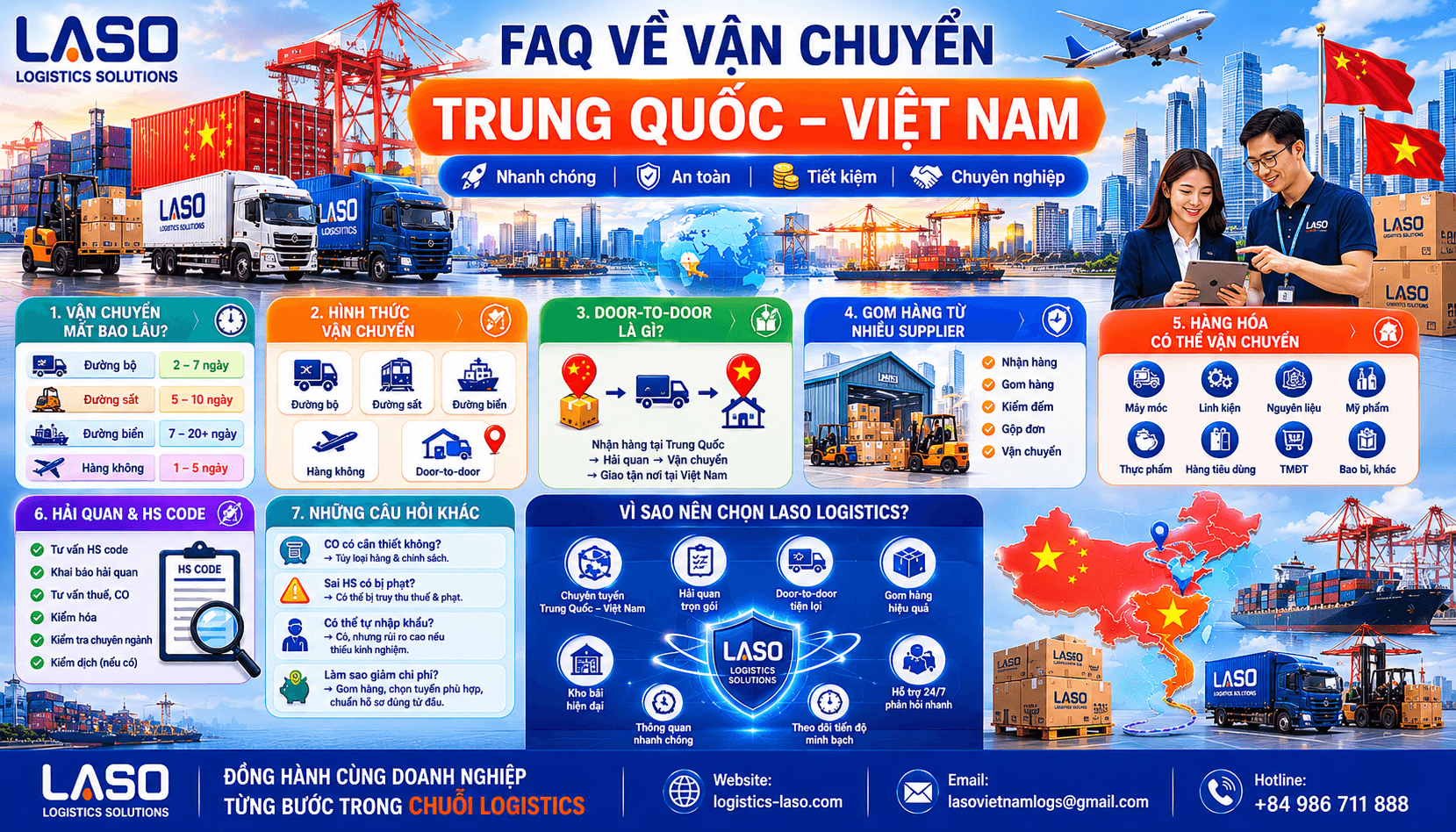
When importing goods from China to Vietnam, many businesses, retailers, and factories frequently raise the same questions regarding shipping, customs, transit times, costs, and risks.
Without a clear understanding from the outset, businesses may encounter:
* Import delays
* Increased logistics costs
* Incurred warehousing / storage charges
* Inconsistent customs documentation
* Customs clearance delays
* Difficulties in inventory tracking
Below are the FAQs – frequently asked questions about China–Vietnam shipping that LASO Logistics regularly receives from clients.
1. How long does it take to ship goods from China to Vietnam?
Transit times depend on:
- Type of cargo
- Shipping route
- Border gate
- Mode of transport
- Customs clearance status
Estimated transit times:
Road Freight
Typically the fastest option for the China–Vietnam route.
Approx.: 2 – 7 days
Rail Freight
Suitable for bulk and large shipments.
Approx.: 5 – 10 days
Sea Freight
Suitable for containerized cargo.
Approx.: 7 – 20+ days
Air Freight
Fastest speed.
Approx.: 1 – 5 days
2. What modes of transport are available?
Popular options:
✅ Road Freight
✅ Rail Freight
✅ Sea Freight
✅ Air Freight
✅ Door-to-Door
3. What is Door-to-Door service?
This is an end-to-end, all-inclusive logistics service.
Including:
- Cargo pickup in China
- Cargo consolidation
- Customs clearance
- Freight transport
- Last-mile delivery in Vietnam
Clients are virtually free from managing any logistics operations themselves.
4. Can cargo be consolidated from multiple suppliers?
Yes.
This is a highly popular demand.
For example:
- Supplier in Guangzhou
- Supplier in Shenzhen
- Supplier in Yiwu
LASO can:
- Receive cargo
- Consolidate shipments
- Conduct tallying/inspections
- Combine orders
- Transport them to Vietnam
5. What types of cargo can be transported?
Extremely diverse.
For example:
- Machinery
- Electronic components
- Packaging materials
- Production raw materials
- Cosmetics
- Foodstuffs
- Consumer goods
- E-commerce cargo
(Certain products require verification of import conditions.)
6. Which goods require specialized inspection?
Depends on the category. Examples include:
- Cosmetics
- Foodstuffs
- Chemicals
- Electrical appliances
- Specialized machinery
- Medical devices
7. Which goods require quarantine?
Examples include:
- Agricultural products
- Foodstuffs
- Timber and wood products
- Animal products
- Certain biological materials
8. Is a C/O (Certificate of Origin) required?
It is not always mandatory.
However, a C/O helps to:
- Prove origin
- Access preferential tax rates (if eligible)
- Support import documentation processes
9. What is an HS Code?
An HS code is an international classification code used to:
- Determine tariffs
- Apply import policies
- Conduct specialized inspections
- Assist customs clearance
Declaring an incorrect HS code poses severe risks.
10. What happens if an incorrect HS code is declared?
Potential consequences:
❌ Retrospective tax assessment
❌ Administrative fines
❌ Physical customs inspection
❌ Customs clearance delays
11. Can businesses handle imports independently?
Yes.
But businesses need a solid understanding of:
- Customs regulations
- Import policies
- HS codes
- Taxes and duties
- Specialized inspections
- Quarantine procedures
Without sufficient experience, risks are significantly higher.
12. What is official import (Chính Ngạch)?
It is the legal, formal method of import with complete documentation and standard customs clearance compliance.
Required documentation includes:
- Commercial Invoice
- Packing List
- Sales Contract
- Customs Declaration
- Tax Payment Receipts
- Valid Import Dossiers
13. How does informal trade (Tiểu Ngạch) differ?
It differs in trade methods and the level of regulatory control. Businesses aiming for long-term operations consistently prioritize the official import channel.
14. Does LASO support customs clearance?
Yes.
Including:
✅ Customs declaration filing
✅ HS code determination
✅ Tax consulting
✅ Physical inspection coordination
✅ Specialized inspection support
✅ Quarantine processing
15. Is fast-track customs clearance supported?
Yes.
Subject to complete documentation and eligible cargo status.
16. Does LASO offer door-to-door delivery?
Yes.
Door-to-door service to:
- Factories
- Warehouses
- Offices
- Designated delivery points
17. Do you support manufacturing enterprises?
Yes.
Including:
- Importing raw materials
- Importing machinery
- Supply chain management
18. Do you support E-commerce logistics?
Yes.
Tailored for:
- Online sellers
- Marketplaces
- Cross-border e-commerce
19. How can logistics costs be minimized?
Several methods:
- Cargo consolidation
- Selecting optimal shipping routes
- Optimizing packaging dimensions
- Preparing accurate documentation from the start
- Partnering with a professional logistics provider
20. Why choose LASO Logistics?
Key advantages:
✅ China–Vietnam route specialists
✅ End-to-end customs clearance
✅ Door-to-door delivery
✅ Consolidation hubs in China
✅ Logistics warehousing
✅ Fast-track customs processing
✅ Hands-on practical support
✅ Nationwide delivery
Which services does LASO Logistics offer?
Our solutions cover:
- China–Vietnam transport
- Official imports (Chính ngạch)
- Customs brokerage
- Door-to-door logistics
- Cargo consolidation
- Machinery & equipment transport
- Manufacturing logistics
- E-commerce logistics
- Cross-border logistics
Contact LASO Logistics
Website: logistics-laso.com
Email: lasovietnamlogs@gmail.com
Hotline: +84 986 711 888
LASO Logistics – Fast consultation, safe shipping, optimized solutions for China–Vietnam importing businesses.