Customs Declaration FAQ
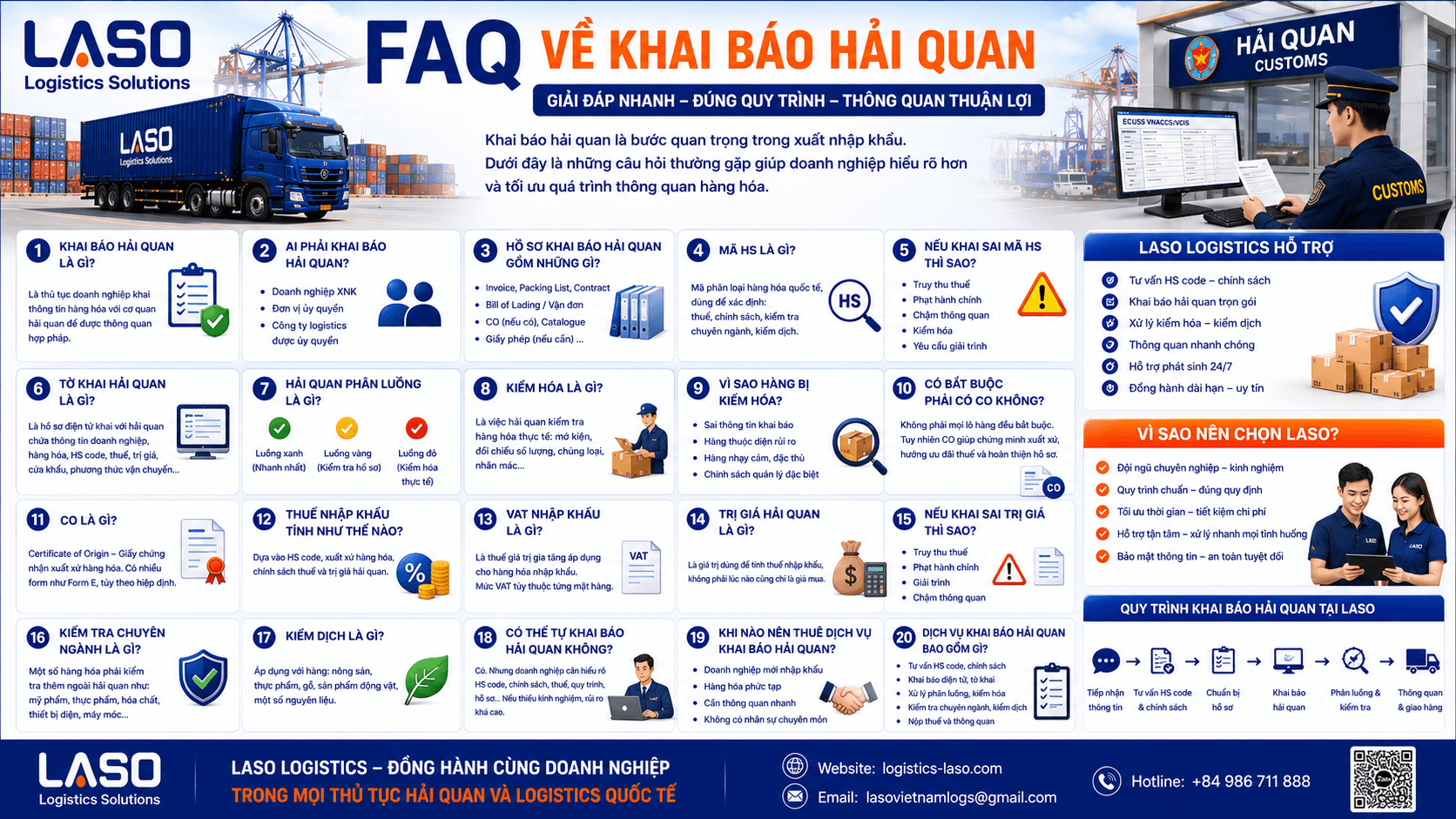
In import-export operations, customs declaration is one of the most critical steps, yet it remains one of the most confusing parts for many businesses. Just a minor error in documentation or declaration can lead to delayed customs clearance, additional costs, or even penalties. Especially for businesses importing goods from China to Vietnam, questions regarding HS codes, duties, documentation, physical inspection, and customs procedures arise very frequently.
Below is the FAQ – frequently asked questions about customs declaration that businesses often care about.
1. What is customs declaration?
Customs declaration is the procedure that businesses perform to declare cargo information to the customs authority during import or export.
Information typically includes:
Product name
HS code
Quantity
Value
Origin
Duties/Taxes
Regulatory policies
Objective:
To ensure goods are inspected and legally cleared.
2. Who must perform customs declaration?
Common entities:
Importers
Exporters
Authorized representatives
Authorized logistics companies
If the business does not handle it internally, they can hire customs declaration services.
3. What documents are required for customs declaration?
Depending on the type of cargo.
However, common documents include:
Invoice
Packing List
Contract
Bill of Lading
CO (if applicable)
Catalogue
Technical specifications
Permits/Licenses (if required)
4. What is an HS code?
The HS code is an international product classification code.
Used to determine:
Import duties
VAT
Import policies
Specialized inspections
Quarantine
This is an extremely critical component.
5. What happens if an incorrect HS code is declared?
The risk is very high.
Potential consequences:
❌ Tax reassessment
❌ Administrative fines
❌ Delayed customs clearance
❌ Physical inspection
❌ Request for explanation
6. What is a customs declaration form?
This is an electronic document declared to customs.
It contains:
Company information
Cargo details
HS code
Duties/Taxes
Value
Port of entry/exit
Transportation mode
7. What is customs channeling?
After declaration, the customs declaration form may be routed into the following channels:
Green channel
Fastest.
Typically:
No detailed document review
No physical inspection
Yellow channel
Document review.
Red channel
Physical inspection of goods.
8. What is physical inspection?
It is the process of customs physically inspecting the goods.
For example:
Opening packages
Verifying goods
Checking quantities
Verifying product names
9. Why are goods selected for physical inspection?
Some reasons include:
Incorrect information
System risk profiles
Sensitive goods
Suspicion of misdeclaration
Special regulatory policies
10. Is a Certificate of Origin (CO) mandatory?
It is not mandatory for every shipment.
However, a CO can help:
Prove origin
Enjoy preferential duty rates
Complete documentation
11. What is a CO?
Certificate of Origin.
For example:
Form E
Other forms depending on trade agreements
12. How are import duties calculated?
Depending on:
HS code
Origin
Tax policies
Declared value
13. What is import VAT?
It is the Value Added Tax applied to imported goods.
The VAT rate depends on each specific product.
14. What is customs value?
It is the value used to calculate taxes.
It is not always just the purchase price.
15. What happens if the value is misdeclared?
Potential consequences:
❌ Tax reassessment
❌ Fines
❌ Request for explanation
❌ Delayed clearance
16. What is specialized inspection?
Some goods require additional inspections outside of customs.
For example:
Cosmetics
Foodstuffs
Chemicals
Electrical equipment
Specialized machinery
17. What is quarantine?
Applies to goods such as:
Agricultural products
Foodstuffs
Wood
Animal products
Certain raw materials
18. Can a business perform customs declaration on its own?
Yes.
However, businesses need to understand:
HS codes
Product policies
Duties/Taxes
Declaration procedures
Documentation
Physical inspection
If lacking experience, the risk is quite high.
19. When should a business outsource customs declaration services?
Highly recommended if:
The business is new to importing
Complex goods
Fast clearance is required
Lack of specialized in-house staff
Frequent imports
20. What do customs declaration services include?
Typically includes:
HS code consultation
Document review
Electronic declaration
Customs declaration forms
Handling channel routing
Physical inspection support
Specialized inspection and quarantine support
Tax payment assistance
Customs clearance
21. How long does customs clearance take?
Depends on:
Type of cargo
Documentation
Channel routing
Specialized inspection
It can range from a few hours to several days.
22. Can a misdeclaration be corrected?
Yes, it is possible.
However, it depends on the situation.
It must be handled in accordance with regulatory procedures.
23. Does Laso Logistics support customs declaration?
Yes.
Services include:
✅ HS code classification
✅ End-to-end customs services
✅ Physical inspection support
✅ Specialized inspection support
✅ Quarantine support
✅ Fast customs clearance
24. Why should you choose Laso Logistics?
Benefits:
✅ Reduced risk of documentation errors
✅ Optimized customs clearance time
✅ Support in resolving unforeseen issues
✅ Dedicated professional team
✅ Specialization in the China – Vietnam route
How does Laso support you?
Customs declaration
Official import/export
Door-to-door
Consolidation
Cross-border logistics
Fast customs clearance
Manufacturing logistics
E-commerce logistics
Contact Laso Logistics
Website: logistics-laso.com
Email: lasovietnamlogs@gmail.com
Hotline: +84 986 711 888
Laso Logistics – Your partner in all international customs and logistics procedures.