How to Optimize the China – Vietnam Supply Chain
In the context of rapidly growing trade between China and Vietnam, supply chain optimization is no longer just a competitive advantage but has become a survival factor for import, production, and distribution businesses.
Many businesses currently encounter the following issues:
- Shipments arriving later than planned
- Rising logistics costs
- Border congestion causing supply chain disruptions
- Lack of raw materials for production
- Excess inventory
- Incorrect customs documentation
- Delayed delivery to customers
- Over-dependence on a single source
If not properly optimized, businesses may lose:
- Money
- Time
- Customers
- Business opportunities
So, how can the China – Vietnam supply chain be effectively optimized?
**What is the China – Vietnam supply chain?**
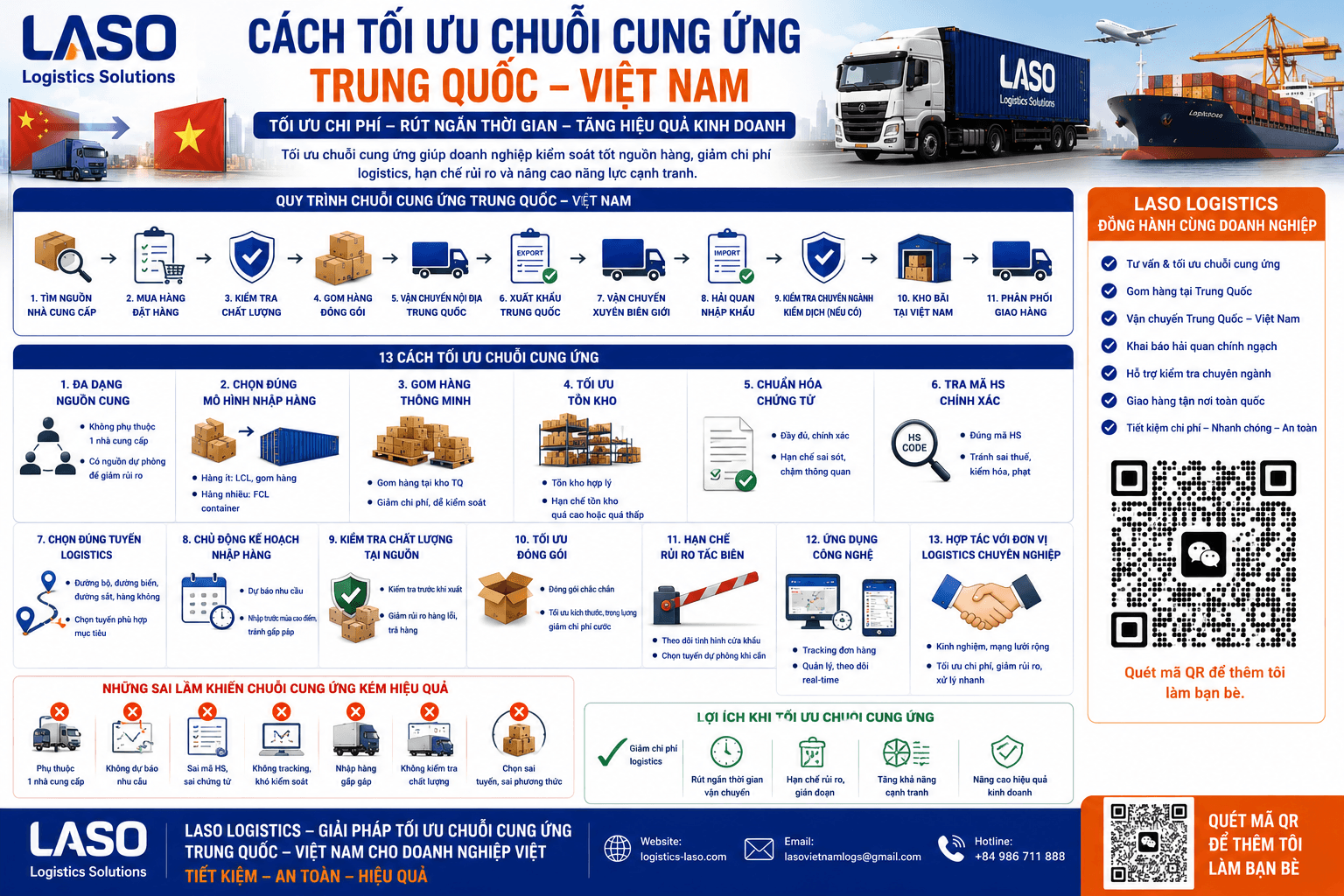
The supply chain is the entire process of moving goods from a supplier in China to a business or customer in Vietnam.
This chain can include:
- Sourcing
- Procurement
- Quality control
- Consolidation
- Packaging
- China domestic transportation
- Exportation
- Cross-border transportation
- Import customs clearance
- Specialized inspection
- Warehousing
- Domestic distribution
In other words: It is the complete journey of the goods.
**Why do supply chain issues frequently arise?**
The China – Vietnam route is influenced by many factors:
- Policy fluctuations
- Border gate congestion
- Customs procedures
- Physical inspections
- Quarantine
- Supplier delays
- Documentation errors
- Peak seasonality
- Freight rate changes
- Container/vehicle shortages
Therefore, optimization is extremely important.
**How to Optimize the China – Vietnam Supply Chain**
**1. Diversify Sourcing**
Common mistake: Depending 100% on a single supplier.
Risks: Factory delays, out-of-stock situations, price increases, quality degradation, or policy changes.
Solution: Maintain a primary supplier and backup suppliers to ensure supply chain stability.
**2. Choose the Right Import Model**
Not all businesses have the same needs. For example:
- Small shipments: Suitable for consolidation (LCL).
- Large shipments: Suitable for full containers (FCL) via formal channels.
The wrong model leads to increased costs.
**3. Smart Consolidation**
If buying from multiple sources in China, instead of multiple small shipments, you should consolidate at a warehouse in China.
Benefits: ✅ Reduced costs ✅ Reduced handling ✅ Easier control
**4. Inventory Optimization**
- Too much inventory: Tied-up capital, increased warehousing fees, risk of dead stock.
- Too little inventory: Stockouts, urgent orders, expensive air freight.
Solution: Determine the optimal inventory level.
**5. Standardize Documentation Processes**
Many shipments are delayed due to faulty documentation. Examples include:
- Incorrect Invoice or Packing List
- Wrong commodity descriptions
- Incorrect HS Codes
- Missing Certificate of Origin (C/O) or permits.
Documentation must be standardized from the start.
**6. Accurate HS Code Classification**
Incorrect HS Codes can derail the entire supply chain, leading to incorrect taxes, physical inspections, clearance delays, and administrative fines.
**7. Choose the Right Logistics Route**
The China – Vietnam route offers several options:
- Road: Fast and flexible.
- Sea: Cost-effective for large volumes.
- Rail: Suitable for specific routes.
- Air freight: For urgent goods.
Choosing the wrong route leads to waste.
**8. Proactive Import Planning**
Common mistake: Ordering too close to the demand date, leading to production delays, expensive air freight, and increased costs. Solution: Establish an import forecast.
**9. Quality Control at Source**
Many businesses only discover defects when goods arrive in Vietnam. Risks include faulty goods, returns, re-importation, and delivery delays. Inspections in China significantly reduce these risks.
**10. Optimize Packaging**
Packaging affects freight rates, damage rates, and container efficiency. Poor packaging results in higher fees and potential losses.
**11. Mitigate Border Congestion Risks**
Be prepared for peak seasons, border gate blockages, or intensified controls.
Solution: Select backup routes, monitor situations closely, and be proactive with schedules.
**12. Implement Tracking & Technology**
A lack of tracking leads to poor control, slow response times, and increased labor. Tracking helps monitor progress, enables proactive coordination, and reduces errors.
**13. Partner with a Professional Logistics Provider**
This is the fastest way to optimize. A good logistics partner will assist with:
✅ Route selection ✅ Consolidation ✅ LCL/FCL optimization ✅ Customs declaration ✅ Handling inspections ✅ Risk mitigation
**Common Mistakes Leading to Inefficient Supply Chains**
❌ Dependence on one supplier
❌ Lack of demand forecasting
❌ Incorrect HS Codes
❌ Poor documentation
❌ Lack of tracking
❌ Wrong route selection
❌ No quality control
❌ Urgent/last-minute importing
**Which Businesses Need Optimization the Most?**
- Manufacturing plants
- Importing SMEs
- Trading companies
- Distributors
- Cross-border E-commerce
- Regular importers of Chinese goods
**Laso Logistics – Supporting China – Vietnam Supply Chain Optimization**
Laso Logistics provides support for:
✅ Consolidation in China
✅ Door-to-door services
✅ Formal importation
✅ Customs clearance
✅ HS Code lookup
✅ Route optimization
✅ Specialized inspection support
✅ Nationwide delivery
**Contact Laso Logistics**
Website: logistics-laso.com
Email: lasovietnamlogs@gmail.com
Hotline: +84 986 711 888
Laso Logistics – Your partner in optimizing China – Vietnam supply chains for Vietnamese enterprises.