
How to Optimize Logistics Costs for Your Business
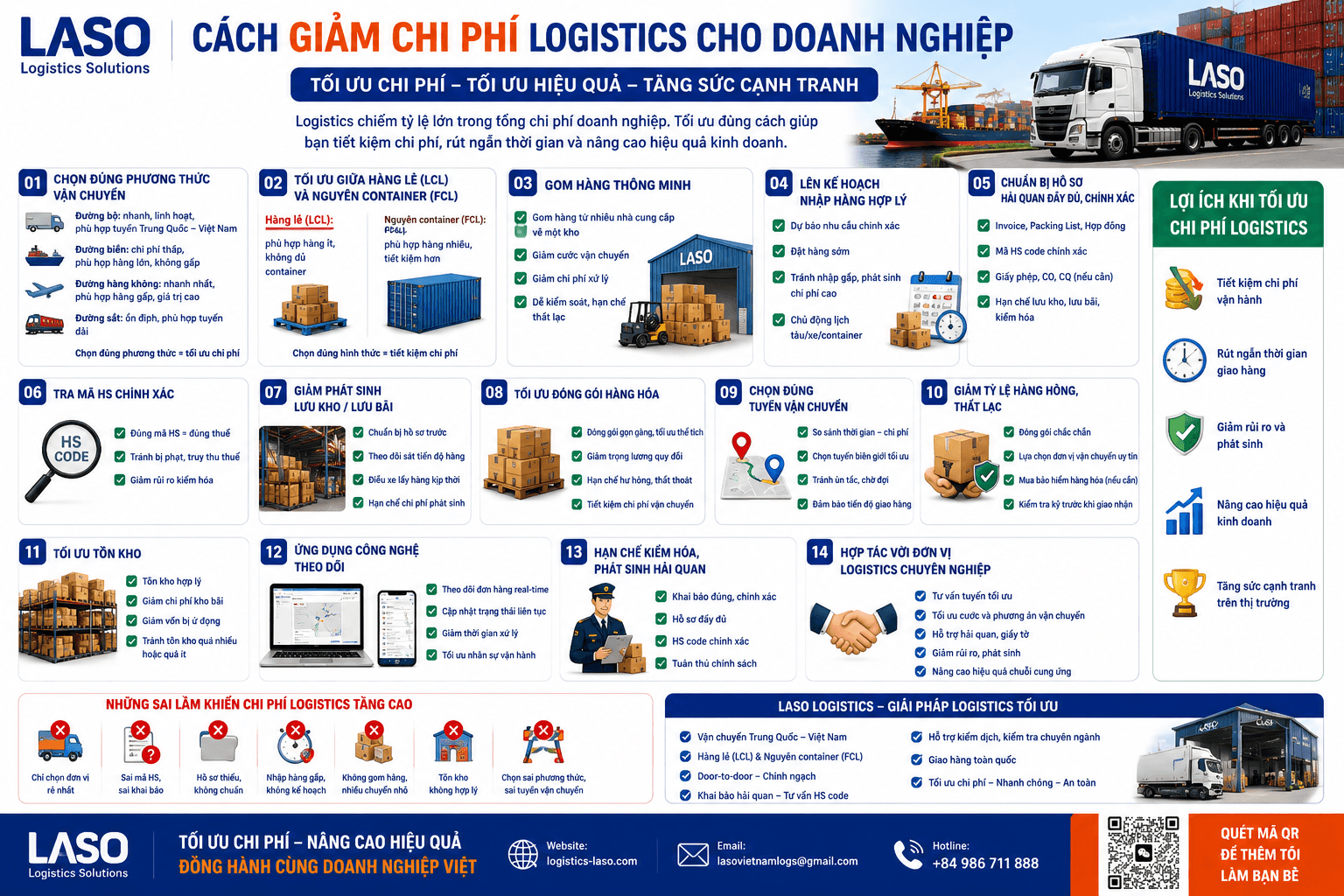
In the context of rising operating costs, logistics is becoming one of the largest expenditures for many businesses, particularly for companies in manufacturing, trade, import-export, and e-commerce.
Many enterprises encounter the following challenges:
- Continuously rising transportation costs
- Incurred storage and demurrage fees
- Delivery delays increasing indirect costs
- Excessive labor for logistics management
- Unexpected customs fees and procedural costs
- Losses resulting from damaged or lost cargo
In reality, reducing logistics costs is not simply about selecting the cheapest provider; it involves optimizing the entire operational chain.
How can businesses effectively reduce their logistics costs?
**Why are logistics costs often high?**
Many businesses focus solely on freight rates. However, actual logistics costs encompass various components:
- Freight rates
- Stevedoring
- Warehousing
- Customs clearance
- Incurred taxes
- Specialized inspections
- Quarantine
- Detention fees
- Operational personnel
- Damaged or lost cargo
Without optimized operations, total costs can be significantly higher than anticipated.
### 1. Select the Right Mode of Transportation
This is the most impactful factor.
**Road Transport**
- Suitable for: China – Vietnam routes, urgent cargo, medium volumes.
**Sea Freight**
- Suitable for: Large volumes, containerized cargo, non-urgent shipments.
- Costs are typically lower per unit.
**Air Freight**
- Fast but expensive.
- Suitable for: Urgent shipments, high-value goods.
**Rail Transport**
- Suitable for specific routes.
*Selecting the wrong mode = sharp increase in costs.*
### 2. Optimize Between LCL and FCL
Many businesses choose the wrong model.
- **Small volumes:** Shipping FCL (Full Container Load) is wasteful.
- **Large volumes:** Shipping LCL (Less than Container Load) becomes more expensive.
*Principle:* Small volume → LCL; Large volume → FCL. Choosing correctly yields significant savings.
### 3. Smart Cargo Consolidation
If purchasing from multiple suppliers, instead of multiple separate small shipments, you should consolidate cargo at a warehouse.
**Benefits:**
✅ Reduced freight rates
✅ Reduced handling fees
✅ Easier control
### 4. Improve Procurement Planning
Many costs arise from urgent imports.
- Example: Opting for air freight due to stockouts, hiring urgent dedicated vehicles, or handling unplanned incidents.
- Proper planning will drastically reduce costs.
### 5. Accurate Customs Documentation from the Start
A costly mistake. Incorrect documentation leads to:
- Clearance delays
- Storage (Demurrage)
- Ground rent (Detention)
- Physical inspections
- Additional processing fees
Required standards: Invoice, Packing List, HS Code, Technical files, and Permits if necessary.
### 6. Precise HS Code Classification
Incorrect HS codes are extremely costly errors. They can cause:
- Tax discrepancies
- Physical inspections
- Documentation adjustments
- Administrative fines
- Cargo delays
Correct classification from the outset significantly reduces costs.
### 7. Minimize Incurred Storage and Demurrage Fees
Many businesses lose substantial amounts here due to:
- Delayed documentation
- Cargo being held
- Delayed trucking coordination
- Lack of a receiving plan
**Solution:** Proactive documentation, advance coordination, and close monitoring of shipment schedules.
### 8. Packaging Optimization
Packaging directly affects:
- Volume
- Volumetric weight
- Freight rates
Bulky, poorly optimized packaging leads to sharp fee increases. Optimization also helps reduce damage, impact, and compensation claims.
### 9. Reduce Damage and Loss Rates
Logistics costs are not just freight. Damaged goods represent a real loss. Causes include poor packaging, incorrect cargo mixing, or substandard transportation.
### 10. Select the Optimal Transit Route
For example, with goods from China, not every route is optimal. Options include: Huu Nghi, Tan Thanh, Chi Ma, Sea routes, or Rail routes. The wrong route = increased time + increased cost.
### 11. Minimize Physical Inspections and Customs Incidents
While they cannot be 100% avoided, risks can be mitigated by: Accurate declarations, standard documentation, precise HS codes, and policy compliance.
### 12. Inventory Optimization
Logistics includes more than just transit. Excessive inventory increases warehousing costs, tied-up capital, and obsolescence risks. Conversely, inventory that is too low leads to urgent imports (air freight) and high costs. Balance is essential.
### 13. Implement Tracking and Order Management
A lack of tracking leads to processing delays, scheduling errors, and increased management labor. Proper tracking reduces operational costs.
### 14. Partner with Professional Logistics Providers
This is the most effective method for many businesses. An experienced partner helps:
✅ Select the right routes
✅ Optimize freight rates
✅ Consult on LCL/FCL options
✅ Standardize customs documentation
✅ Reduce incurred costs
✅ Mitigate risks
**Mistakes that Inflate Logistics Costs**
❌ Choosing solely based on the lowest price
❌ Incorrect HS codes
❌ Missing documentation
❌ Lack of procurement planning
❌ No cargo consolidation
❌ Wrong transportation mode
❌ Lack of inventory control
**Who needs logistics optimization the most?**
- Manufacturing plants
- Import companies
- Distributors
- E-commerce businesses
- SMEs importing from China
- Large supply chain enterprises
**LASO Logistics helps businesses optimize logistics costs**
LASO Logistics supports:
✅ China – Vietnam route optimization
✅ Cost-saving cargo consolidation
✅ LCL / FCL services
✅ Door-to-door solutions
✅ Customs declaration
✅ HS Code consultancy
✅ Minimizing logistics overheads
**Contact LASO Logistics**
- Website: logistics-laso.com
- Email: lasovietnamlogs@gmail.com
- Hotline: +84 986 711 888
**LASO Logistics – Cost-optimized, fast, and secure logistics solutions for your business.**